A clean look on streets, roofs or terraces
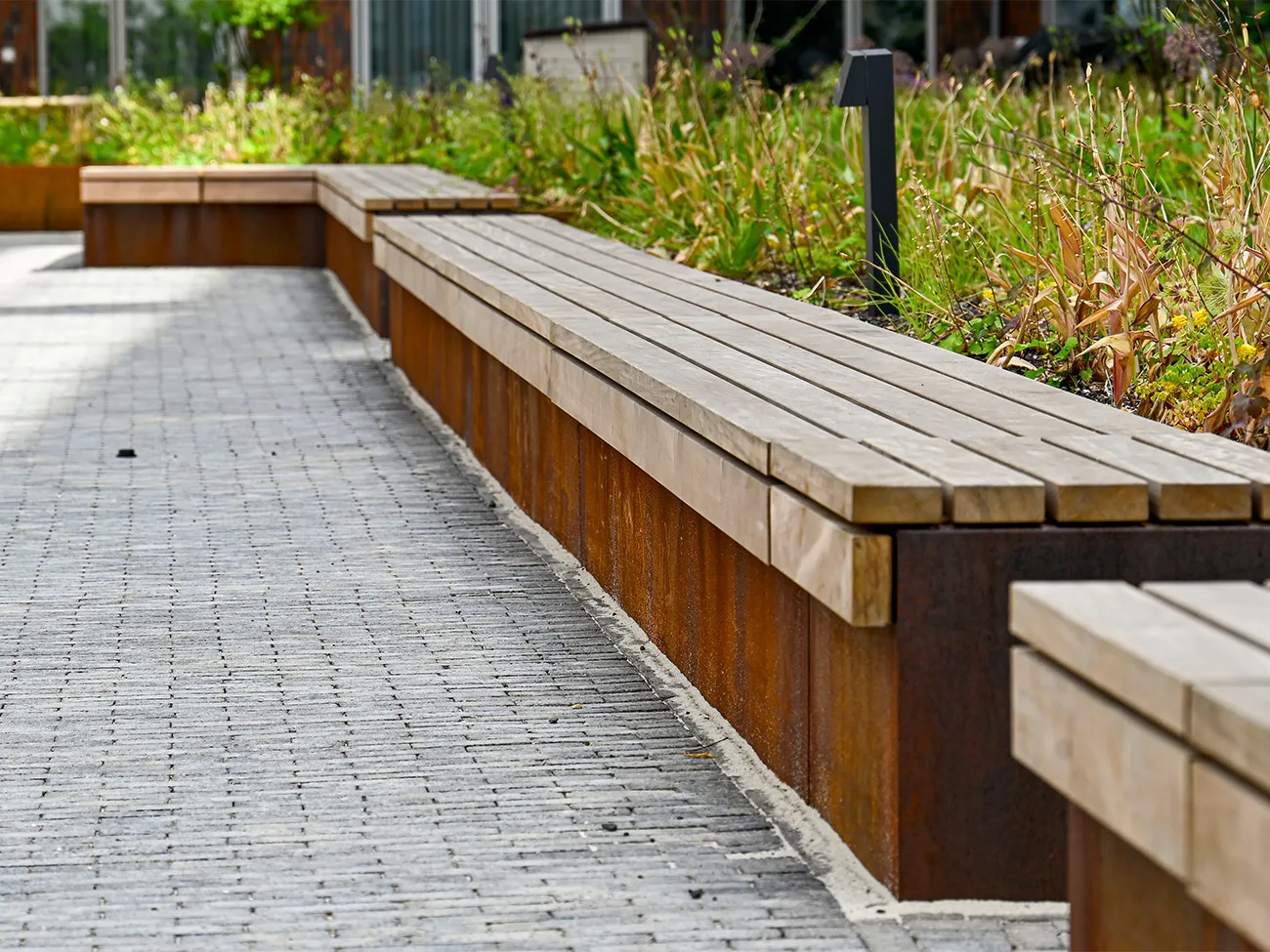
Prefabricated borders and planters offer advantages
Building a brick border or planter is not only time-consuming and costly. Try finding a bricklayer who can do the job quickly and expertly. Staff shortages are also starting to cause problems in the landscaping sector. Manufacturer FURNS from Uden is responding smartly to this challenge by making its planters from aluminium or steel and prefabricating them. This saves not only time and money, but also weight, which is a bonus for roof gardens.
“The trend towards prefabricated construction is continuing,” says Sil van Duijnhoven, co-owner and creative director at FURNS Street Furniture. “There is a major shortage of people not only in housebuilding, but also in infrastructure and landscaping. As a result, people are increasingly looking for prefabricated solutions, and FURNS is fully committed to this approach.”
Using weathering steel or powder-coated aluminium, FURNS offers an alternative to the traditional way of making planters: a brick wall topped with a coping. Van Duijnhoven says: “Simply joining and levelling prefabricated metal border elements lets you quickly create a flower bed or large planting area. As well as saving time, this significantly reduces the weight on roof gardens and can even support circular reuse.”
FURNS not only manufactures planters and border edging, but also holds a substantial range in stock. Van Duijnhoven says: “In every size you can imagine, so we can deliver very quickly. The market appreciates that.”
Changes in level
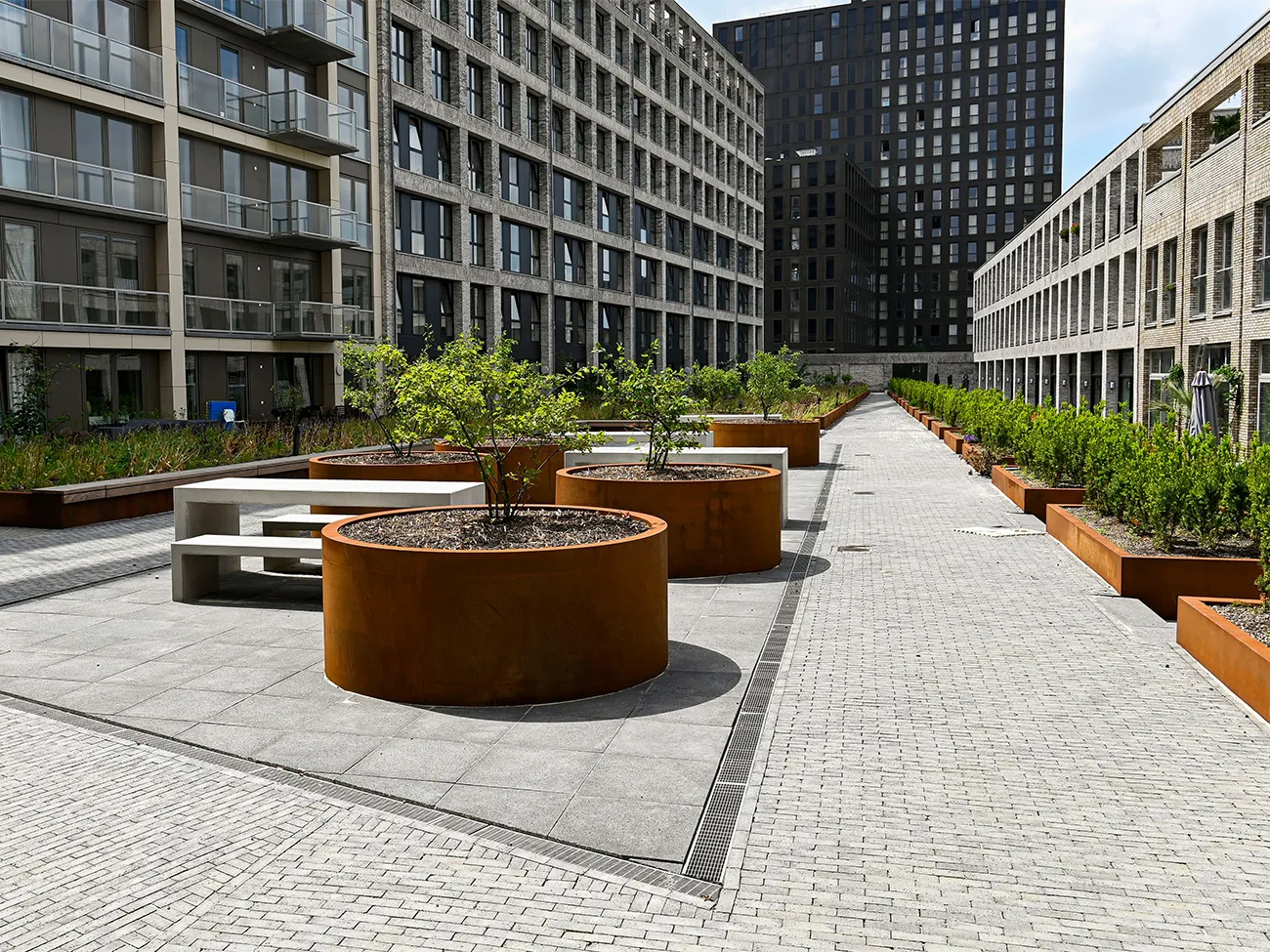
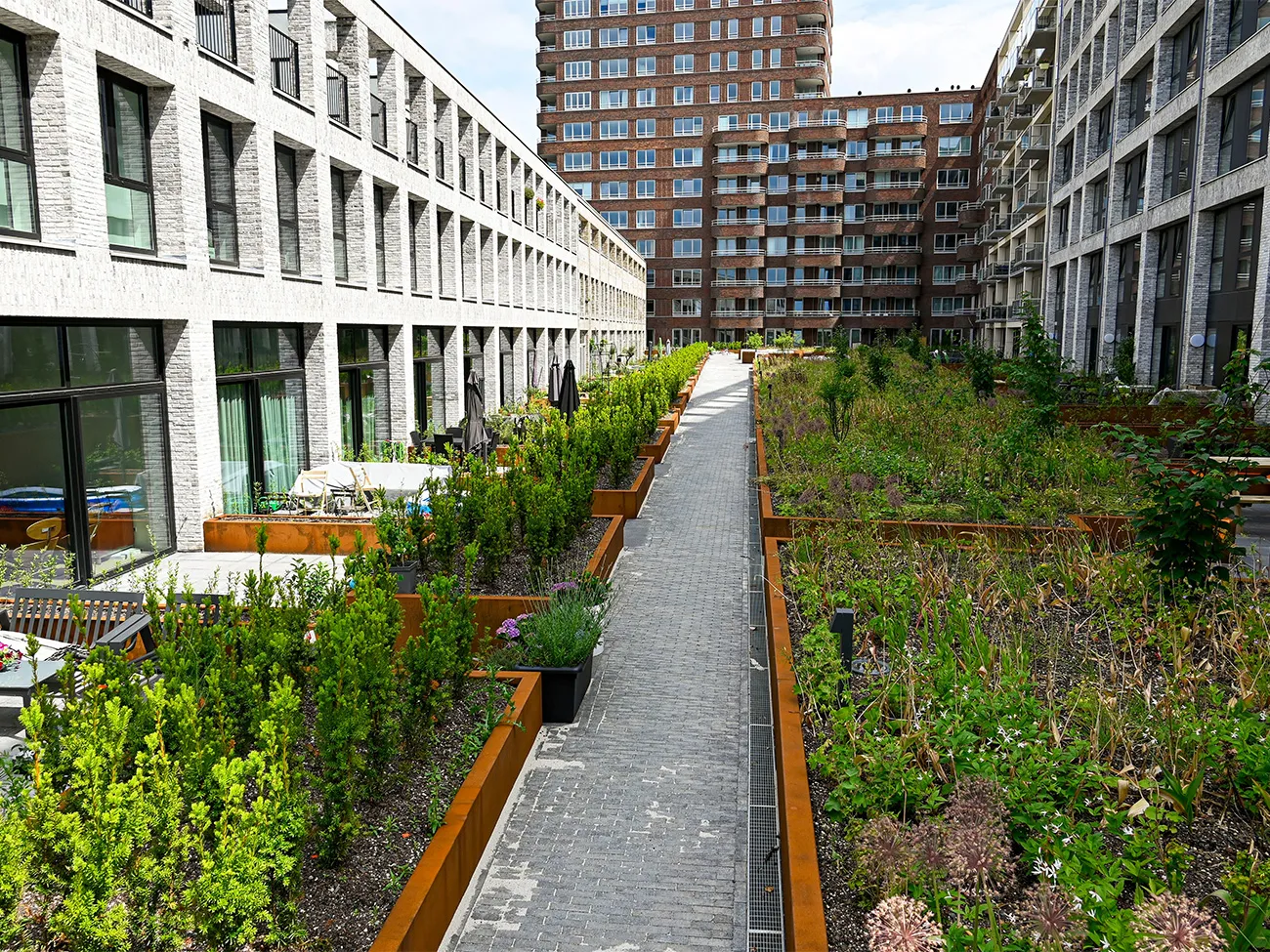
FURNS recently supplied a large quantity of border edging and planters for the Laan van Spartaan project in Amsterdam. Van der Tol Hoveniers created a roof garden there to a design by Rob van Dijk. The garden comprises a private and a semi-public area. Corten steel borders and planters separate the gardens, public garden and areas at different levels.
Van Duijnhoven says: “No less than 33 tonnes of steel were used on this project. That may seem like a lot, but compared with brick borders, we saved a full 210 tonnes in weight. That is a significant reduction for a roof garden.”
Besides the considerable reduction in weight, and therefore the structural savings for the building, FURNS also achieved a substantial saving in time. “Installing a prefabricated planter is not only much quicker, it is also far easier. Think of setting out profiles, pointing, laying foundations, and so on,” says Van Duijnhoven. “Naturally, the preparation takes a little longer. At FURNS, every steel element is fully drawn up in 3D and 2D. These drawings are used by the client as well as by the workshop staff. Fortunately, the drawing process, from weld assembly to 3D file, is fully automated, so it does not take all that long after all.”
Low maintenance
Van Duijnhoven also points out that weathering steel is a durable material that requires little maintenance and is highly resistant to vandalism. “It was originally developed for bridge and shipbuilding. Good drainage and ventilation around the material are important. And thanks to the exceptionally simple bolted construction, elements are easy to reuse. Alongside bespoke products, our range includes a standard line of components that can be interchanged universally,” Van Duijnhoven explains.
Because weathering steel is a pure grade of steel, with no chemical preservatives, it is also highly recyclable. Thirty per cent of the planters and borders manufactured by FURNS are made from scrap.
Question about this story? Ask your question
Keep following this
Get an email when a new story is published. No account needed.
- SubjectConstruction