









Natural grass versus artificial turf: Olivier Vandermotte and Jessie Vermeire of Pro-Pitch on sustainable pitch management
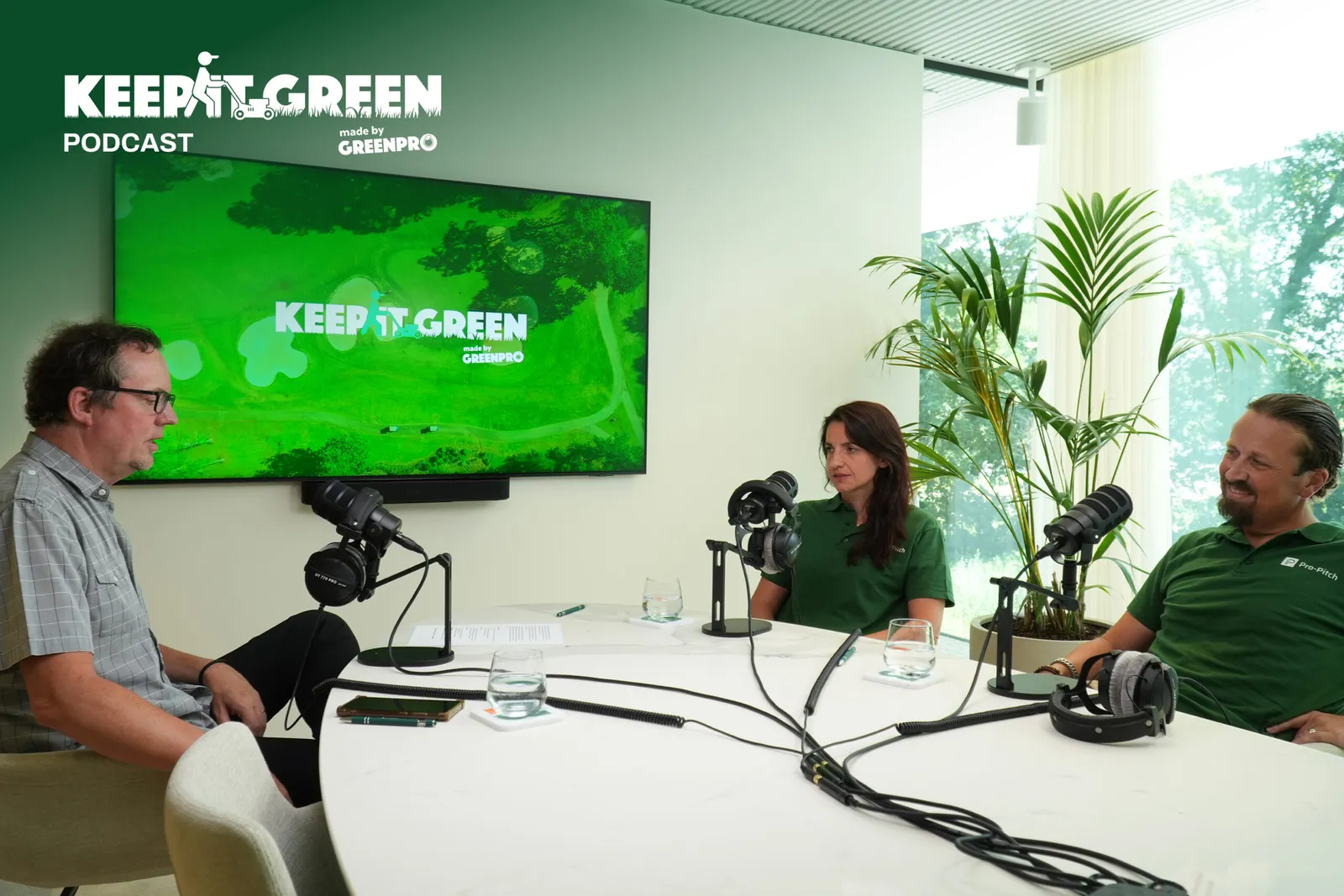
Is artificial turf really more sustainable and easier to maintain than natural grass? In this episode, Kris Vandekerckhove talks to Olivier Vandermotte and Jessie Vermeire of Pro-Pitch about the sustainable management of football pitches. They explain why healthy soil, good water infiltration, deep rooting and data-driven grounds management are essential for a strong natural turf surface. Artificial turf, plant protection products, climate change, maintenance costs and the service life of sports pitches are also discussed. A conversation about using fewer chemicals, harnessing the natural strength of grass and taking a long-term approach to sustainable sports facilities.
Een zakelijke vraag aan Pro-Pitch®? Get in touch
Full transcript
All chapters (14)
- Introduction: fewer chemicals, harnessing the natural strength of grass
- Use of chemicals and plant protection products
- Artificial turf as an alternative
- Sealing beneath artificial turf
- Service life and disposal of artificial turf
- Natural grass, climate and maintenance
- Soil as the foundation
- Data-driven grounds management
- Climate change and the resilience of natural grass
- Quality standards and public green spaces
- Tailored work
- Service driven by a love of sport and grass
- Sustainability and a long-term vision
- Closing
Introduction: fewer chemicals, harnessing the natural strength of grass
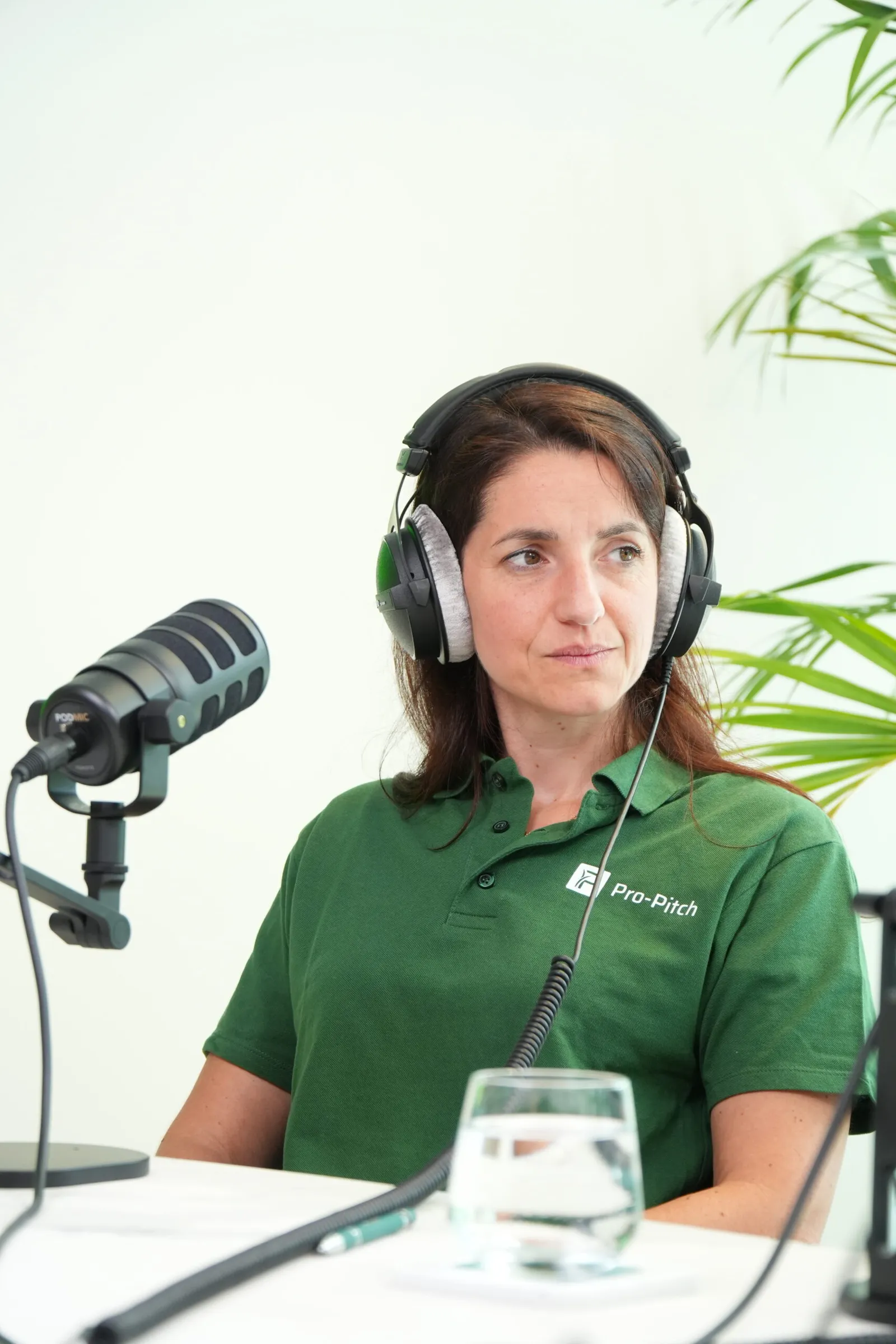
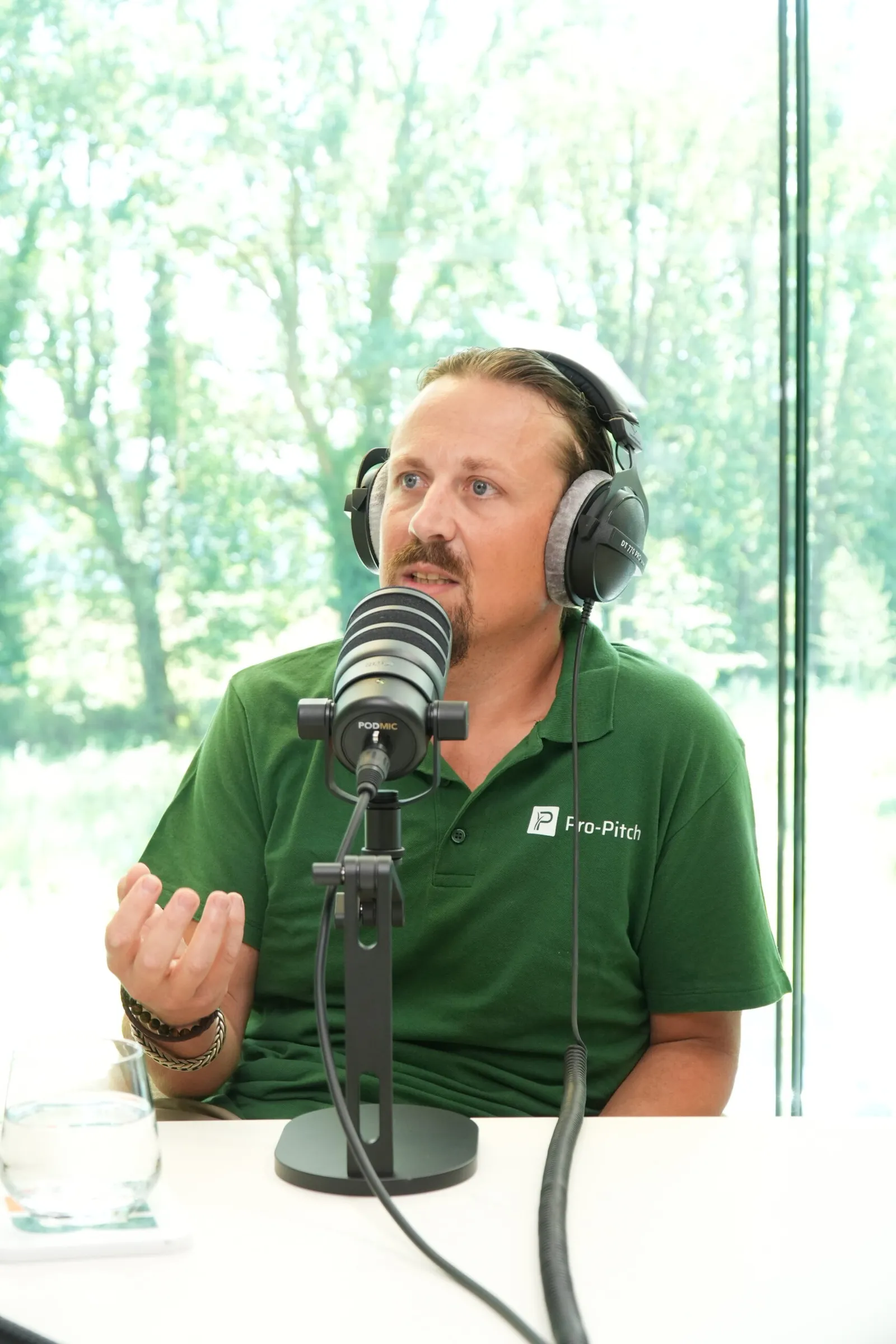
Kris Vandekerckhove Welcome to the podcast studios at Louwers Mediagroep. Today we have a special guest. Someone who spent many years working in the international industry and commodities sector, with a focus on all things chemical. But today he is making a passionate case for something we often take for granted: natural grass. My guest is Olivier Vandermotte, Managing Director of Pro-Pitch. Does he help sports clubs, local authorities and organisations not only maintain their pitches better, but also manage them more sustainably, with greater climate resilience and a stronger focus on the future? Also joining us at the table is Jessie Vermeire, who is responsible for all administrative and logistical matters at Pro-Pitch. Welcome to you both. Our starting point: fewer chemicals, harnessing the natural strength of grass. What does that mean in practice?
Olivier Vandermotte Well, the two biggest problems facing smaller local football clubs are weeds and a relatively weak turf surface. What we call a very thin sward. By using fewer chemicals, we mainly mean […] making sure the pitch is in good condition, densely covered and resilient. That is the essence of the slogan. We want to provide a high-quality natural turf surface using as few intensive or capital-intensive inputs as possible.
Use of chemicals and plant protection products
Kris Vandekerckhove But in your view, how much chemical treatment is still being used?
Olivier Vandermotte Very little chemical treatment is used nowadays. That is also because legislation on plant protection products has changed significantly in recent years. A thinning sward gives weeds far more opportunity to establish. Local clubs then look for products that will allow them to keep using plant protection products on their pitches, officially or otherwise. We would say that plant protection products are not needed to keep weeds out of the sward.
Jessie Vermeire We don’t need them, and we don’t want them used where children play.
Read the full transcriptCollapse transcript12 more chapters
Artificial turf as an alternative
Kris Vandekerckhove We should always think of our children and the future of this planet we live on. We only have one, so we have to make the best of it. But I’ve also learned that, to avoid all those complicated procedures and regulations, many football clubs choose artificial turf. And I think that’s where we have a problem, because it is often sold as sustainable. But do you agree?
Olivier Vandermotte Why do clubs make the case for artificial turf? They want a surface that lets them keep playing through the winter, on a pitch that remains playable. They think it requires little maintenance, so they look for ways to justify the investment. But that’s not right, because you’re laying 7,000 square metres of plastic. Underneath it is a surface, whereas with the right approach and soil structure, and a minimal number of interventions that are also far less capital-intensive, you can achieve the same result.
Sealing beneath artificial turf
Kris Vandekerckhove We’ll come to that shortly, because first I want to get artificial turf out of the way, literally. First of all, you say artificial turf is laid on a sealed surface, even though further sealing is no longer allowed. How does that work exactly?
Olivier Vandermotte It’s important to be clear about what counts as sealing and what doesn’t. We see local authorities that have an obligation to remove sealed surfaces, whether imposed by the Flemish Government or not, having no problem providing a fairly impermeable surface for an artificial turf pitch, while a natural grass pitch would be sealed over. They then have to remove the sealed surface somewhere else. That simply creates even more costs and problems for local authorities.
Service life and disposal of artificial turf
Kris Vandekerckhove And what happens to an artificial turf pitch at the end of its service life? I wonder because it won’t last for ever. What happens to it?
Olivier Vandermotte It gets scrapped. It may be sent for waste processing as a new recycled material or raw material. Processing it takes a huge amount of energy, because energy has to be added again.
Natural grass, climate and maintenance
Kris Vandekerckhove So we want to return to natural grass. Is it better for the climate? I’ll start there. Is it better for the climate?
Olivier Vandermotte Absolutely. A natural turf surface absorbs CO2 and stores it in the soil. If you renew the turf every year, that is obviously less straightforward. Plastic does not absorb CO2 and does not photosynthesise. That much is fairly obvious.
Kris Vandekerckhove Exactly, good. But what we hear, or what people think, is that natural grass needs a great deal of maintenance, and a lot of work to keep it thick and looking green, this, that and the other. You can certainly set that straight.
Olivier Vandermotte Yes, absolutely. If you compare the investment in an artificial turf pitch with the maintenance costs of a […] the figures don’t add up. Anyone who says otherwise is being very creative with the numbers. If you provide a normal, organic, permeable surface and enough nitrogen to sustain the growth of the grass plant, you have the recipe for a dense sward. That’s all you need to do. Look after the soil and soil life, and maintain the permeability of air and water. With nitrogen and sunlight, you have all the right ingredients.
Soil as the foundation
Kris Vandekerckhove And how do you do that in practice? We all know that natural grass, or grass in general, starts with good soil. What does that involve?
Olivier Vandermotte It’s very simple: put a spade in the ground and look at what you’ve brought up. Nine times out of ten, on all the pitches you’ve seen so far, you’ll find incredibly compacted, dark soil with plenty of nutrients. But years of people walking and playing on it, along with rainfall, cause it to compact naturally. The sand particles press together, making it much harder for oxygen to get into the soil. Water also drains through much less easily. You can tell simply by looking. It costs nothing. We come out, put our little spade in the ground and say: this is what we’re going to do. Often the first step is to look at how we can improve permeability, so the roots have room to develop. Those roots also give the turf surface stability when moisture levels rise in winter. But if you leave it for years, the soil becomes compacted. Completely compacted. That is obviously why I come out in the first place: the sward has thinned and weeds have appeared, or there are puddles that won’t drain away. So, to answer your question, we take a look at the soil and a small sample, and if necessary have it analysed. Ideally, we do that to establish exactly what the soil contains in terms of organic matter, nitrogen, phosphorus, potassium and trace elements. We can then draw up a detailed plan for the club, based on the type of pitch, the underlying soil and the playability requirements, and prepare a cost plan and management plan to see them through the season. That way, they know exactly what to do and when, and what not to do.
Data-driven grounds management
Kris Vandekerckhove Very important. Yes, there are of course tools and apps to help with that.
Olivier Vandermotte Yes, absolutely. There is a strong trend towards data-driven grounds management, and it is essential. Data is hugely important, as is monitoring your parameters consistently. Consistency means working in a standardised way. We take and record measurements at regular intervals, and visualise them, so we know exactly where there is a problem with permeability or soil acidity. But you do need to measure a set of standard parameters at regular intervals, because what gets measured gets managed. We won’t make assumptions or rely on a gut feeling to say: I think you should do this or that here. We investigate it properly, literally from the ground up.
Climate change and the resilience of natural grass
Kris Vandekerckhove I can imagine a lot of people saying: that’s all very well, but what about the changing climate? Summers are getting drier, and downpours are becoming almost tropical in intensity. Can a natural grass pitch withstand that, even if it’s well maintained and you follow the principle that what gets measured gets managed?
Olivier Vandermotte Yes, absolutely. It needs a period of dormancy in summer. It can take a real beating, so to speak. There may be a heatwave, or a water shortage lasting a few days or weeks. Your grass can cope. You certainly don’t need to panic if it suddenly turns brown, for example. But you do need to bear in mind that a thin, depleted sward is vulnerable. Good, deep rooting is important. If you keep the grass healthy and disease-resistant, it can withstand heat, disease and fungal infections. Of course, once the plant is gone, it’s gone.
Kris Vandekerckhove Yes, that’s right.
Olivier Vandermotte And that’s the key. Don’t let it die off. Look after it, and it can easily last 25 years.
Quality standards and public green spaces
Olivier Vandermotte Shouldn’t we perhaps just let go of the idea that everything has to be neat and sterile? On a football pitch, it can be uniform. There will certainly be different grass species growing there, but when it comes to football pitches, there is a certain quality standard to meet. And how we manage things in our gardens or in public green spaces is a different matter. That calls for a different approach too, to prevent nuisance and keep our roads clean and free from encroaching weeds. So in that respect, every pitch needs its own approach. Does everything have to be neat and sterile? On a football pitch, yes.
Kris Vandekerckhove Yes, that’s right. We want to see those lovely stripes on TV, don’t we?
Tailored work
Kris Vandekerckhove Jessie, I’d like to finish with you. We’ve covered a lot of information here. We’ve really gone into great depth. But why, Jessie, should people get in touch with you when they want their pitch in tip-top condition?
Jessie Vermeire Because. First of all, we tailor our work to each client. I think that’s really important. We always go and look at the football pitch in person, to see what condition it’s in. For that same football pitch. But actually, I don’t think I need two minutes, because what I often say is: I’m a little biased, because I know he’s a good one, seeing as I married him. But let him come over and people can judge for themselves. That’s really it.
Service driven by a love of sport and grass
Kris Vandekerckhove Is there anything you’d like to add, Olivier?
Olivier Vandermotte It’s hard to say no to her. No, but we complement each other really well in that respect. Thanks to her, I can develop my passion further. I’d say, in a professional way. We want to provide a service to the club, and not leave clubs feeling that they’re third or fourth in the queue behind a bigger or better-known contractor. No, we really do this out of love for the sport and for grass. And above all, so that our children and future generations can play on natural grass.
Sustainability and a long-term vision
Kris Vandekerckhove That’s right. Thank you for sharing your insights with us today. What I’ll take away most from this conversation is that sustainability isn’t always about new technologies, chemicals or major investments. Sometimes the solution lies in better understanding, maintaining and strengthening what is already there, what nature already offers us. Whether that means sports pitches, public green spaces or the way we treat our living environment. Our children. And as we’ve heard today, that impact often starts with a considered long-term vision and a little spade in the ground.
Olivier Vandermotte A little spade in the ground, that’s right.
Closing
Kris Vandekerckhove Thank you for listening to this podcast. Did you find this episode interesting? Subscribe to our podcast on Spotify and stay up to date with inspiring stories, innovative projects and sustainable solutions helping to shape the world of tomorrow. See you in the next episode.
Companies in this story
Keep following this
Get an email when a new story is published. No account needed.
- ThemeSports pitches under heavy use
- SubjectGeneral
- CompanyPro-Pitch®







