Comfortable paths from hole to hole
Text Elise NoyezImage Koers
Low-maintenance paths for the golf sector
When people think of a golf course, they picture the vast green expanses of the fairways and greens. But of course, there is much more to a golf course than that. Water features, parkland and natural areas, and paths also require maintenance at a golf club. Fortunately, with the right construction and products, path maintenance can be kept to a minimum, leaving greenkeepers with more time and room to focus on what matters most.
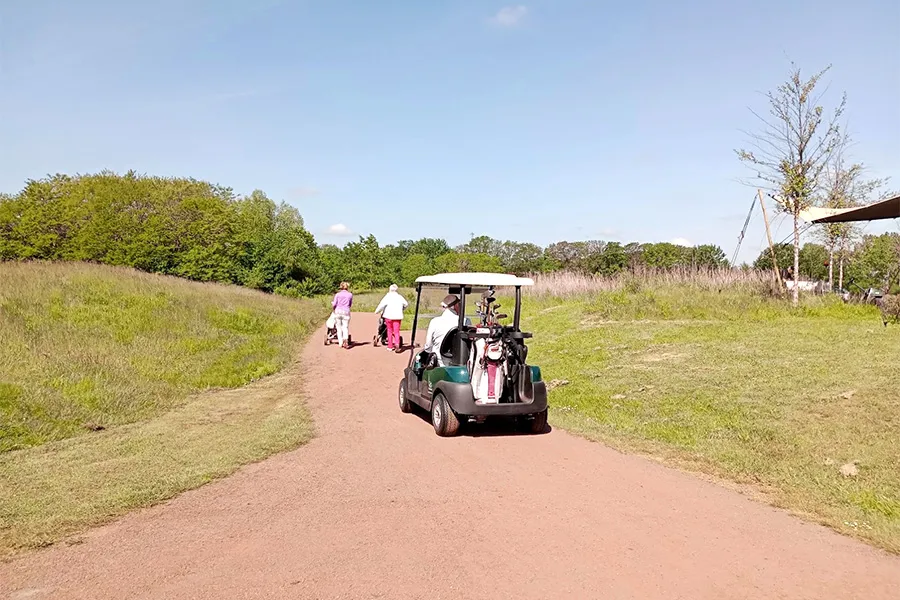
Paths are essential for guiding golfers comfortably from tee to green and from hole to hole, whether they make the journey on foot or by golf buggy. Unfortunately, they can also give greenkeepers a few headaches. Traditional solutions using shells, dolomite or loose gravel do not always provide adequate protection against weeds, can become difficult to use in wet weather and wash away quickly in such conditions, meaning they need topping up regularly. This is precisely why Noord-Nederlandse Golf & Country Club in Glimmen has had all
its paths replaced with Koers semi-bound surfacing over the past few years.
Sustainably produced semi-bound surfacing
Originally from the Netherlands, Koers is a family business with more than a hundred years of history and over twenty-five years of experience in developing and producing semi-bound surfacing. Through its Koersmix range, the company offers three main types for the golf sector: mineral-bound, highly permeable KoMex (natural, yellow, red and anthracite) and DurEko-mix (grey mottled); plant-bound KoMex BIO and DurEko-mix BIO; and the extra-stable, plant-bound KoTRec BIO (natural), reinforced with a geopolymer. All products have been developed in-house and are made at a sustainable, virtually CO2-neutral production site. The use of high-quality, partly recycled raw materials, extensive pre-treatment and computer-controlled mixing ensure not only the quality of the Cradle to Cradle, or C2C, certified finished products, but also consistency and continuity in their composition.
Choosing the right product
In most cases, the choice of Koersmix product depends on the subsoil. The mineral-bound and standard plant-bound solutions, for example, are particularly suitable for sandy soils, while KoTRec BIO is the recommended solution for heavier soils such as clay.
Aesthetic and maintenance considerations can also influence the choice. After winter, KoMex (BIO) and DurEko-mix (BIO) semi-bound surfacing is best given a thorough service, including filling in any depressions and compacting the surface again. KoTRec BIO does not even require this.
Thanks to its exceptionally robust composition and minimal loose material, any dirt can simply be swept away. However, KoTRec BIO must be laid within a few days of production. Unlike the other Koersmix products, in other words, greenkeepers cannot simply keep it in stock to make quick, flexible repairs to any damage.

More than 2,500 m2 of paths
Although Nederlandse Golf & Country Club in Glimmen is on sandy soil, KoTRec BIO was chosen for this project because it requires little maintenance.
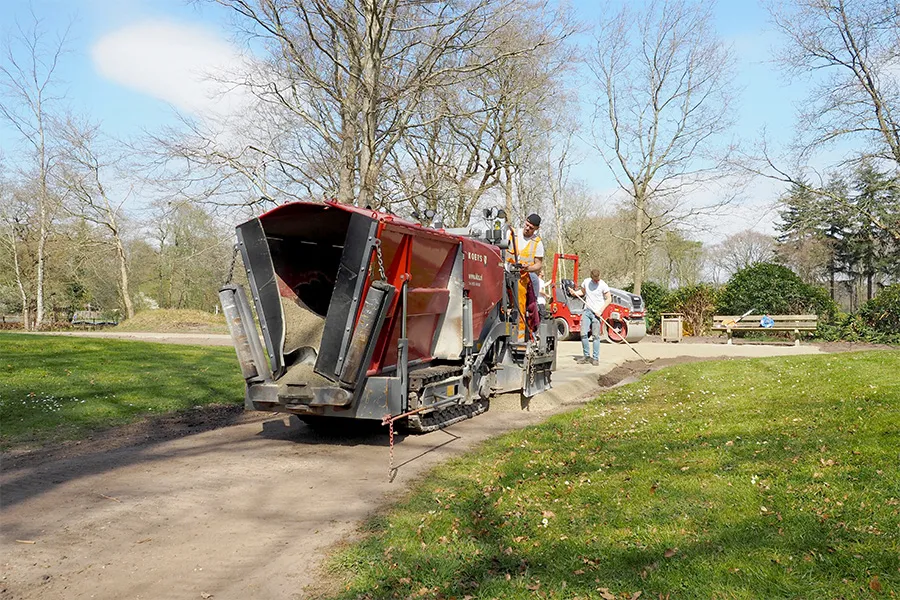
In 2020, 560 m2 of the existing paths were first lifted, re-profiled, compacted and finished with KoTRec BIO. Two years later, the greenkeepers were convinced of the quality of the solution, so all the remaining paths, a total of 2,000 m2, were treated in the same way.
In this case, Koers carried out and supervised the entire installation, but capable greenkeepers can also do the work themselves. Bear in mind, though, that KoTRec BIO is best laid mechanically. Koers’ other semi-bound surfacing products can be laid either manually or mechanically.
Question about this story? Ask your question
Keep following this
Get an email when a new story is published. No account needed.
- ThemeKeeping golf courses playable all year round
- SubjectSports grounds & golf courses