Quercus ilex: a characterful evergreen hedge
Box hedges have had a hard time in recent years in our part of the world, thanks to the box tree moth. Holly, yew and hornbeam are good alternatives, but if Hugo Maes has his way, Quercus ilex (holm oak) will be the hedge of choice. Maes is one of the few people in our country to specialise in growing this hardy woody plant from southern Europe and North Africa.
The holm oak stands out for its thick, leathery, dark green leaves, with a felted grey, silvery underside. In May and June, it produces an abundance of soft yellow flowers. The leaves may have smooth or holly-like toothed margins. Quercus ilex is evergreen, but may lose some of its leaves during prolonged cold spells. These are immediately replaced by fresh new growth. Its evergreen foliage makes the holm oak particularly suitable for planting as a hedge.
Looks good clipped into a neat shape
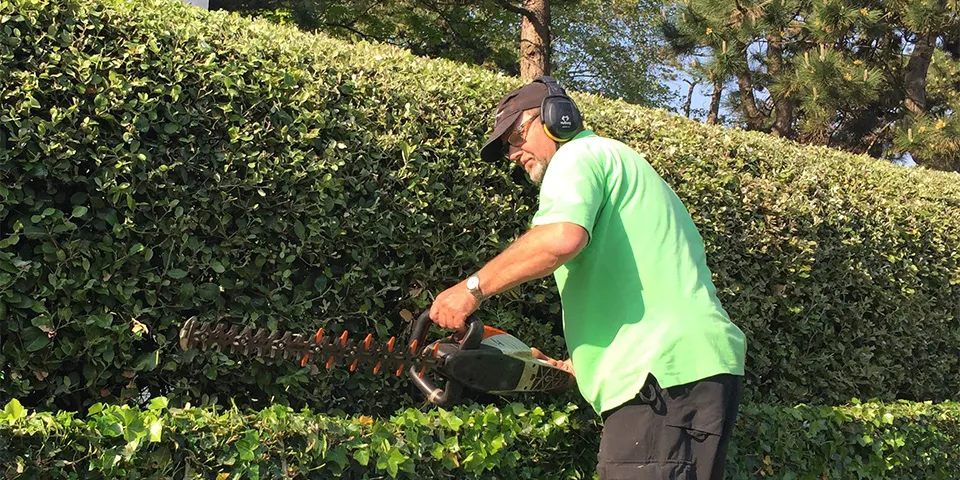
The holm oak is naturally a tree that can grow tall in its native habitat. However, young plants respond well to formative pruning, allowing them to be kept in check and shaped into neat, compact, dense hedges or screens. Two trims a year, in April and September, are enough to maintain a good hedge shape. Looser forms are also possible, in which case one trim is sufficient.
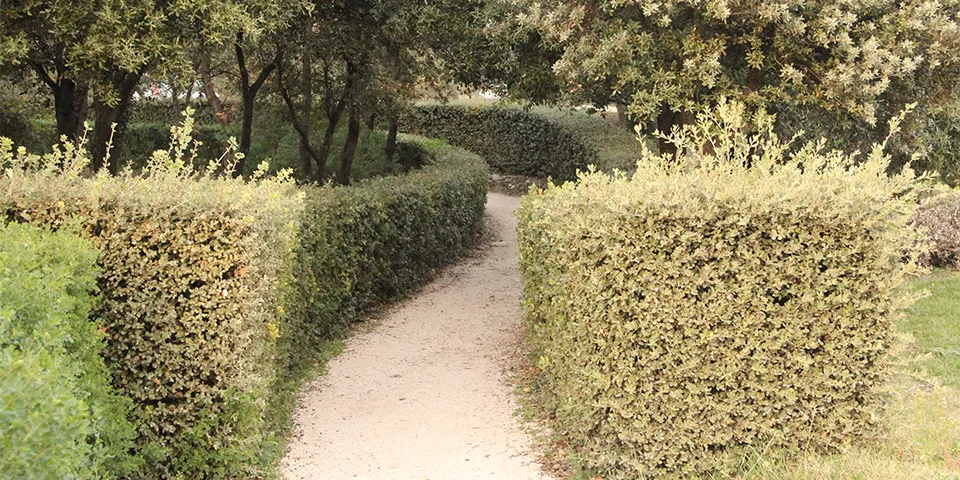
Quercus ilex hedge in a playful, curved shape.
Boundary, garden room, windbreak
Holm oak hedges are remarkably versatile. More and more garden designers are planting them in their own gardens, which speaks volumes. Quercus ilex hedges can serve as almost impenetrable garden boundaries, ensuring complete privacy. Varying the height of the clipped sections can also create beautiful, intimate garden rooms. Quercus ilex also thrives in salty, often windy coastal climates, which is why it is frequently planted in coastal gardens as a highly resilient, evergreen windbreak.
Resilient in every respect
Hugo Maes travels to southern France every year. High in the cold hills of the garrigue, on its limestone-rich soils, he collects ripe, pointed holm oak acorns. He germinates them himself and grows them on into hedge plants. The care taken during cultivation allows the plants to adapt to our climate and soil conditions, making them hardy down to at least -18°C. Regular pruning and meticulous care of the young plants ensure they develop into well-branched, dense specimens that quickly establish themselves in their new surroundings after transplanting.
By carefully selecting the seeds himself, Maes has produced holm oaks grown locally with much smaller leaves than imported Italian specimens. Hugo Maes’s pioneering work over many years has led more and more garden designers to specify plants of Belgian origin, particularly for their attractive leaf shape and size.
Question about this story? Ask your question
Keep following this
Get an email when a new story is published. No account needed.
- SubjectProduct information