Battery-powered chainsaws make life easier for arborists
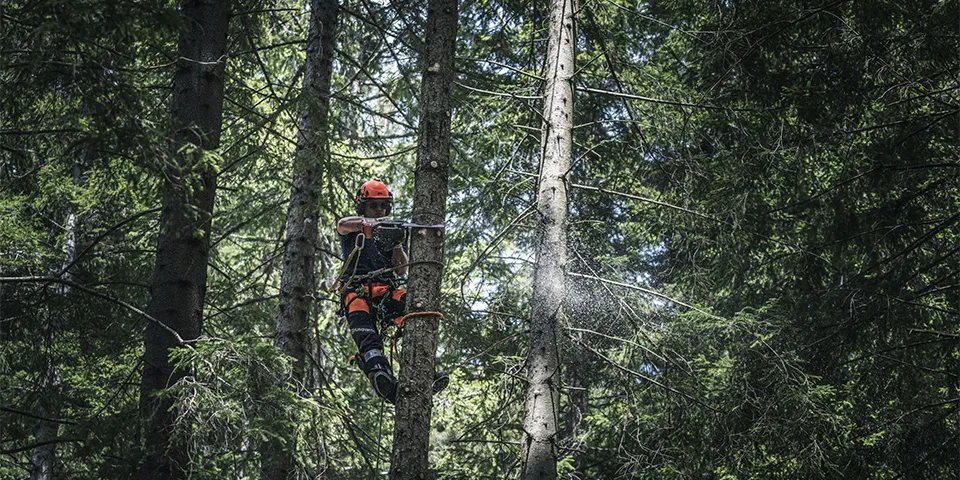
Scott Forrest and Josephine Hedger highlight the key features a chainsaw needs for their work, and share their…
Give two experienced (and award-winning!) arborists a new battery-powered chainsaw and you can be sure they will put it through its paces. Scott Forrest and Josephine Hedger, aptly named, highlight the key features a chainsaw needs for their work and share their experiences with the latest additions to the Husqvarna family: the T540i XP and the 540i XP.
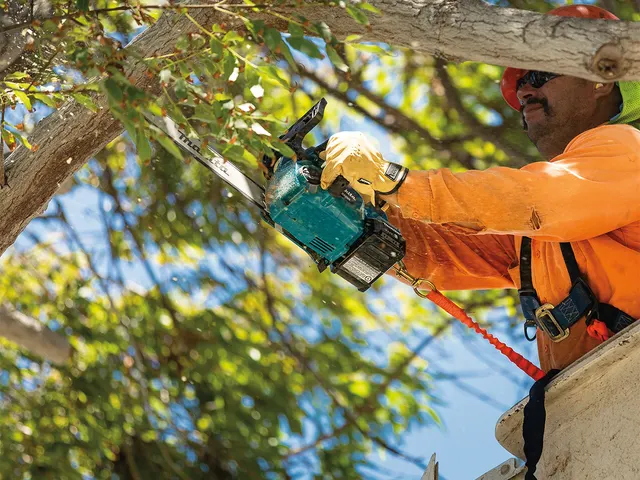
Climbing high into trees to prune, fell or maintain them can be challenging work, as Forrest (New Zealand) and Hedger (United Kingdom) know better than most. They have been in the trade for 22 and 18 years respectively, and last year both claimed the world tree-climbing title for the fourth time. “An arborist has countless factors to take into account,” says Forrest, “and our efficiency depends on more than just the power of our tools. A machine’s start-up time, our manoeuvrability and the visibility of our work also affect how quickly, safely and efficiently we can do the job.” Or, as Hedger puts it: “When we use a chainsaw, it has to feel like an extension of our body.”
Weight and balance
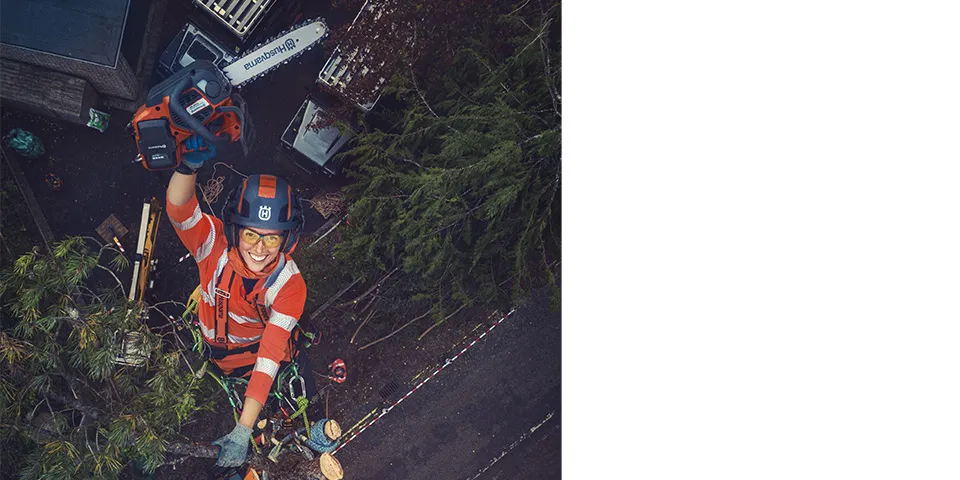
Like tens of thousands of arborists around the world, Forrest and Hedger make their way through branches and climbing ropes to reach the treetops every day. “It takes a lot of physical effort,” admits Hedger, “so the less extra weight we have to carry, the better.” When developing the new Husqvarna T540i XP, designed specifically for arborists working at height, particular attention was therefore paid to reducing the weight of both the machine and its battery. The result is a battery-powered top-handle chainsaw that weighs 400 g less than its petrol-powered counterpart.
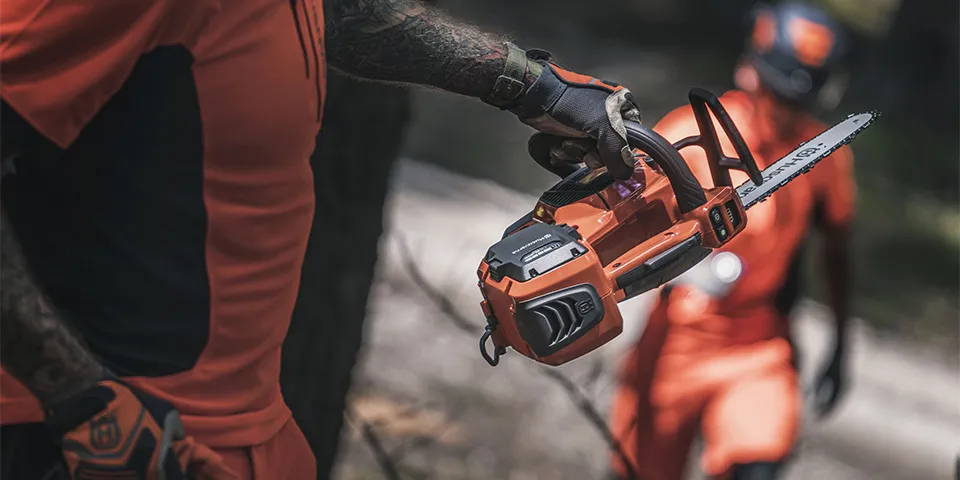
The weight of the machine and battery has been reduced so that the T540i XP weighs 400 g less than its petrol-powered counterpart.
But weight is not the only consideration when climbing smoothly to the top. “When you have to move through a dense canopy, you don’t want your equipment getting caught up in it,” says Forrest. “You need to be streamlined. The closer your equipment is to your body, the better. A loop at the rear of the saw, so you can attach it directly to your harness with a carabiner, is a real bonus.”
Then there is the sawing itself, which is physically demanding too. Hedger says: “We are never simply standing upright. We often have to contort ourselves, and when pruning we tilt the chainsaw in every direction. If the machine is unbalanced, that can quickly take its toll on your elbows, shoulders and so on. The balance of these chainsaws has been meticulously fine-tuned. Even the battery is positioned to keep the balance right, including when you use a smaller battery.”
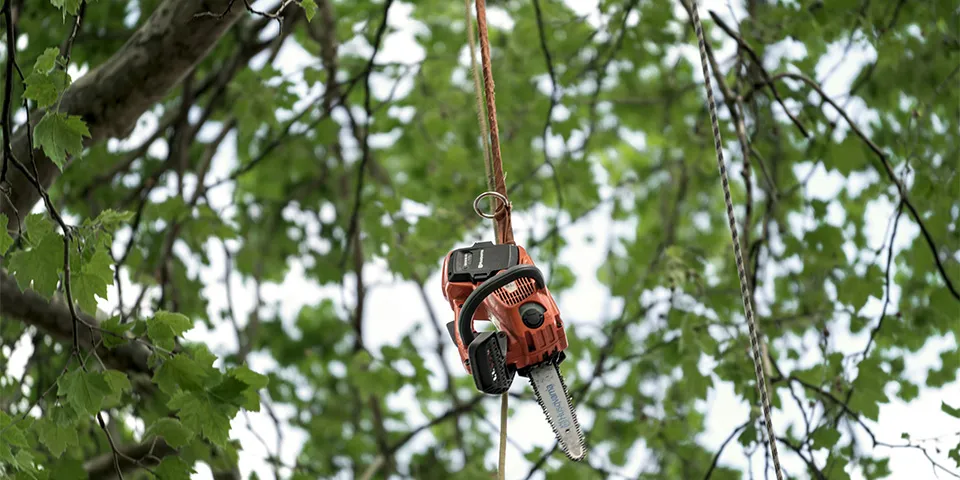
In the trees, an arborist is never simply standing upright. Balance is therefore crucial for both the person and the tool.
Versatile and reliable
Having just climbed up into a tree’s crown, you obviously don’t want to have to come down every half-hour to change equipment. “That used to be a problem with battery-powered tools,” admits Hedger. “Because the power output was lower, you still had to switch to a petrol chainsaw for heavy-duty work. But the T540i XP delivers the same power and chain speed as the conventional T540 XP (40 cc), and the same goes for the 540i XP rear-handle chainsaw. I can trust these machines to handle diameters of up to 30 to 40 cm, so I rarely have to switch to a petrol chainsaw.” The new SP21G chain, combined with the X-Precision bar, also helps deliver a strong, efficient cut, and has another benefit too.
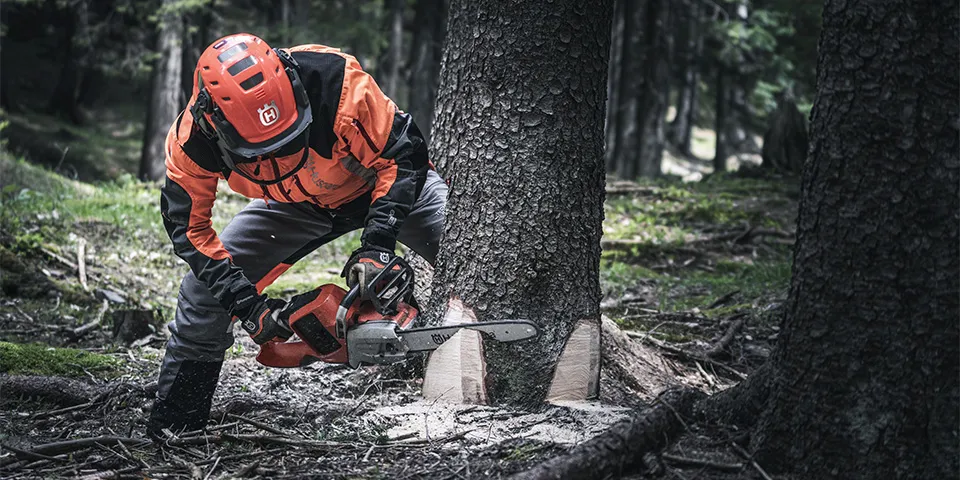
Forrest says: “The new chain gives an exceptionally smooth and precise finish, helping the pruning wound heal much better. And there’s no need to take out our handsaw as well.”
Reliability is another consideration. “Before I start a job, I want to be sure there’s enough battery charge left to finish it,” says Hedger. “I now know that the top-handle saw needs one or two fully charged batteries for a working day, while the 540i XP sometimes needs a third. The clear battery indicator also shows me at any time what I can and can’t get done. And thanks to its IPX 4 rating, I know the saw will keep performing in the rain.”
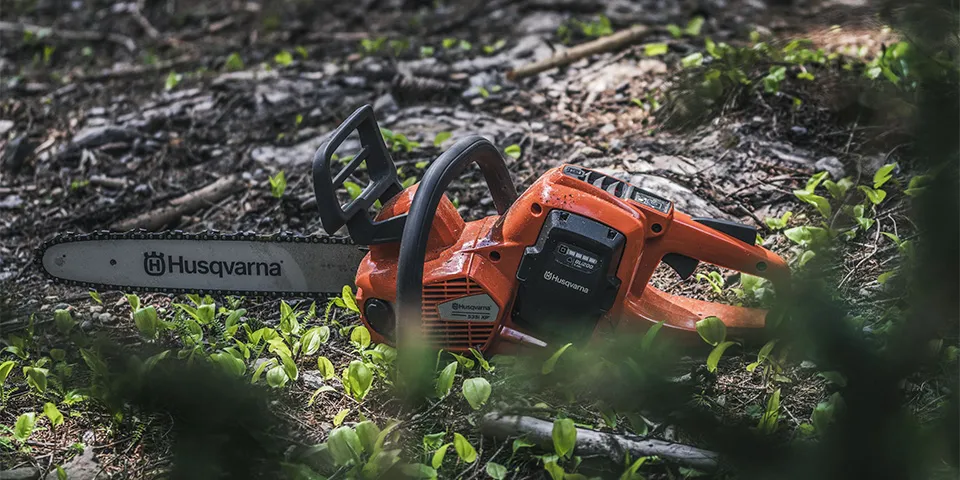
The weight of the machine and battery has been reduced so that the T540i XP weighs 400 g less than its petrol-powered counterpart.
Ready to go straight away
One of Hedger’s main reasons for choosing a battery-powered chainsaw is its quick response time. “Top-handle chainsaws are notorious for being left running unnecessarily for much of the time,” says the Briton. “You don’t want to have to pull-start a chainsaw when you’re in an insecure position, or keep waiting for the engine to warm up fully. So petrol-powered saws are switched off as little as possible. That in turn leads to pollution, safety risks and excessive fuel consumption.”
“A battery-powered saw, by contrast, can be switched on and off up to 30 times an hour, and delivers full power every time you press the button. The only thing to look out for is a start button that feels just right, so you don’t have to search for it. For me, the T540i XP has already brought a huge gain in efficiency, while reducing a lot of stress and nuisance.”
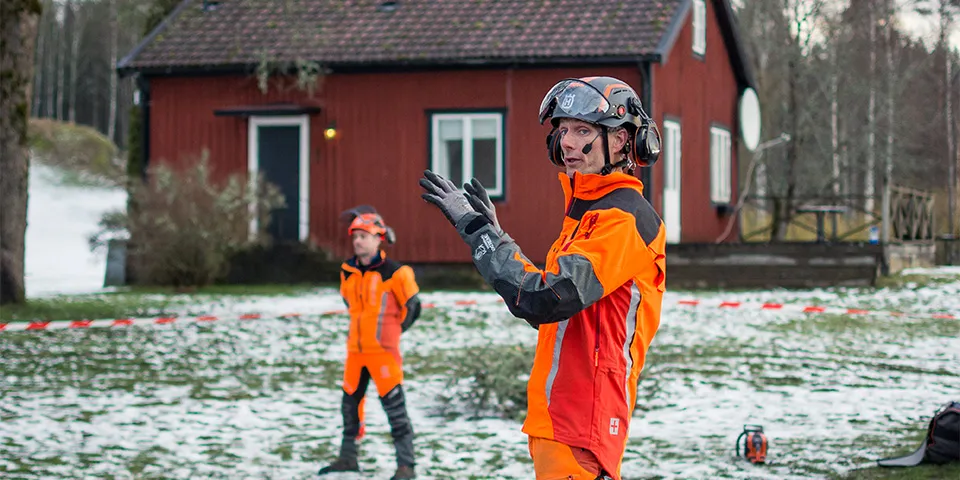
“Good communication between us is essential,” says Scott Forrest. “The less noise our tools make, the better we can communicate.”
Safety first
Stress, fatigue and frustration are major risks for arborists. They can lead to mistakes and, as a result, injuries. “Exhaust fumes, noise and vibration are generally the biggest sources of stress,” says Hedger. “The more you can eliminate them, the better.”
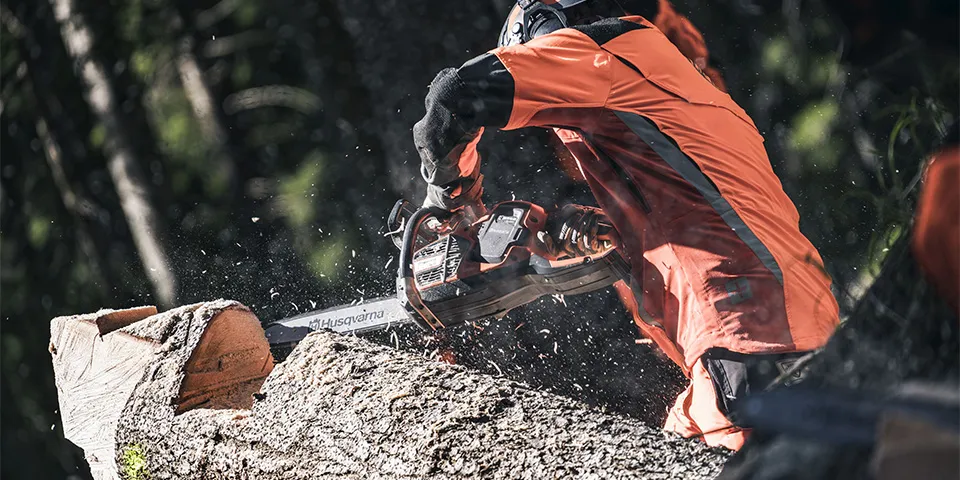
Because more cutting is done from the ground, the 540i XP needs 2 to 3 batteries for a full working day. The top-handle saw gets by with 1 to 2 batteries.
Although this was not always possible in the past, the emergence of high-performance battery saws for green-industry professionals is opening up a new world of possibilities. “When we have to work in a dense canopy in summer, we are no longer surrounded by our chainsaw’s exhaust fumes; we can use the chainsaw all day without risking exceeding the safety limits for exposure to vibration; and we no longer have to deal with the enormous stress of constant exposure to noise.” “Our customers are no longer disturbed by the noise either, so they’re happier with us,” adds Forrest, “and communication between us is much easier. That too is crucial for a safe and pleasant working environment.”
“The idea that arborists are so worn out after the age of 30 that they can no longer work is outdated,” concludes Hedger. “With machines like these, I see no reason why we can’t keep doing this job until we’re 50 or 60.”
Question about this story? Ask your question
Keep following this
Get an email when a new story is published. No account needed.
- SubjectProduct information