How to extend the life of cylinder mowers
Text Kris VandekerckhoveImage Milati Grass
The art of grinding
Milati Grass Machines serves a wide range of professionals, including sports turf managers, field managers, greenkeepers and landscapers. Its versatile range includes various line-marking paints and lime spreaders, as well as products from Foley Company, such as grinding machines and other greenkeeping tools.
Arjen Spek, managing director of Milati Grass: “What is often overlooked, or at least not done very well, is cylinder mower maintenance, especially the blades. A cylinder mower has two key components: the cutting cylinder and the bedknife. Together, they work like a pair of scissors, cutting the grass. But there is much more to it than that. There are two important terms to remember: ‘quality of cut’ and ‘aftercut appearance’.”
Follow the manufacturer’s guidelines
“It’s important to maintain the cylinder as specified by the manufacturer,” says Arjen Spek. “And of course, this varies considerably by brand. You want the aftercut appearance and quality of cut to remain exactly as the engineer of the brand in question intended. People commonly talk about ‘grinding the cylinders’. This involves sharpening the cutting cylinder at the front face of the blade. The same applies to the bedknife.
Finished? Not quite!
“Over time, the cutting cylinder becomes conical in shape because its blade follows a helix. It isn’t flat. As a result, one end of the blade wears faster than the other.”
The Pi tape method
Arjen Spek: “This naturally has implications for the grinding process. When you ‘spin-grind’ the cylinder, you need to remove this conical shape, or taper. There are several ways to do this. One example is the well-known Pi tape. It gives a quick, direct reading of the mean diameter, accurate to the nearest micrometre. You do this by placing the tape around the circumference of the cutting cylinder. First place it at one end, then at the other. This tells you where more grinding is needed. Some people use a calliper for this.”
Cylinder mower maintenance with Foley grinders
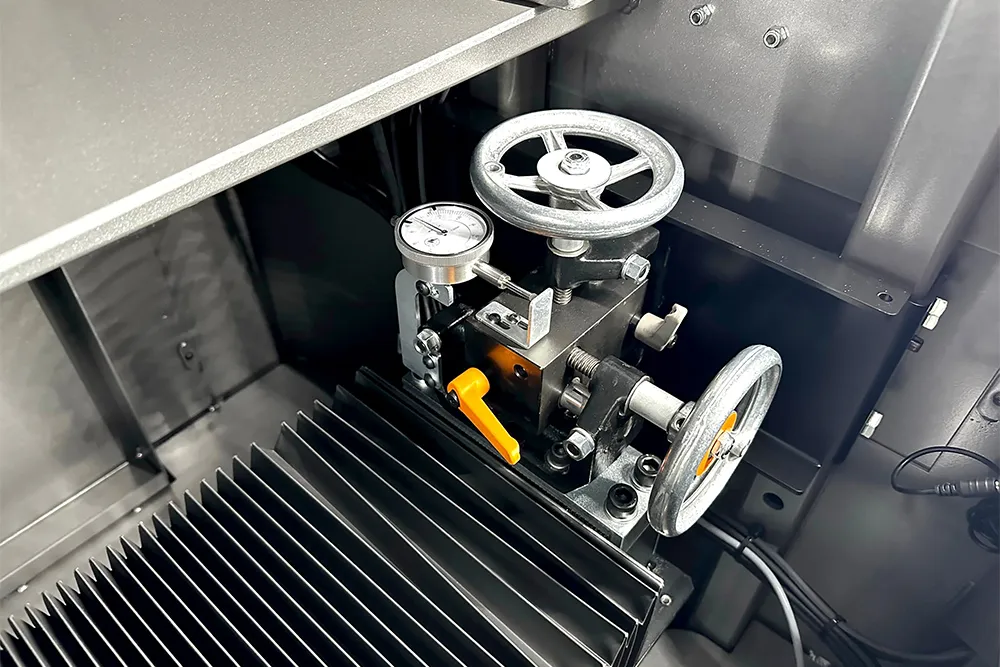
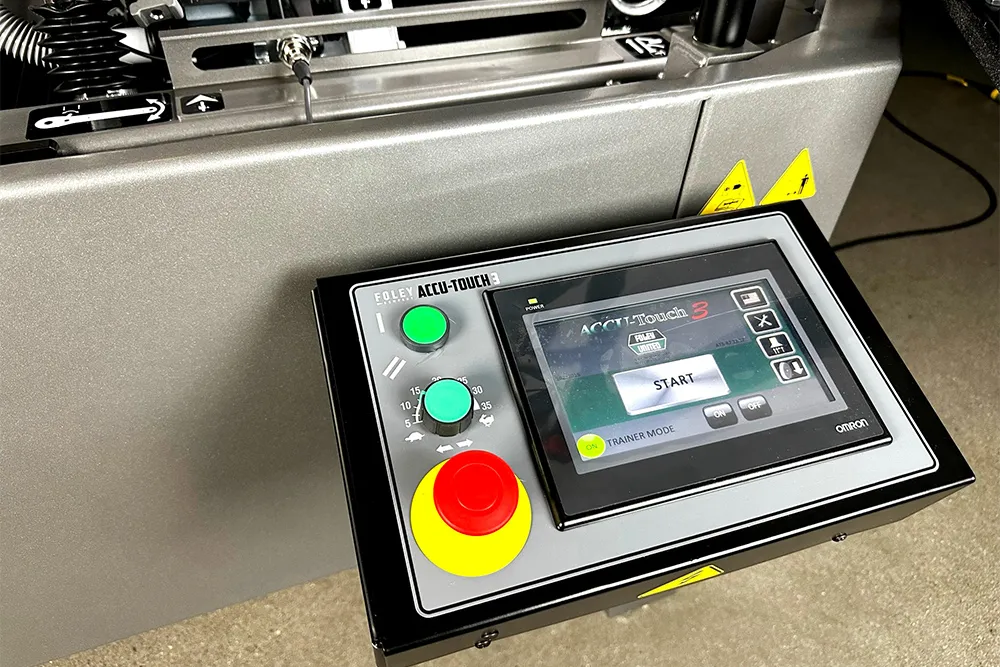
“Of course, there is a much easier way,” Spek continues. “That’s where Foley grinders come in. Foley is the only brand in the world that accurately measures the cutting cylinder shaft and ensures it is parallel to the grinding wheel shaft. The machine automatically calculates where more or less material needs to be ground off, until the cutting cylinder is perfectly cylindrical again, rather than conical.
A Foley machine grinds across the entire cylinder, rather than first grinding one end and then the other, which can often make the cylinder even more conical. Another advantage is that the cutting cylinder and bedknife can work without any tension, which in turn helps extend the overall life of your cylinder mower.”
“Besides spin-grinding, relief grinding is also important. Every cutting unit from all the well-known brands has a specific relief angle. This can vary by brand, but the current Foley grinders have this information built in. By spin-grinding the cutting cylinder to make it cylindrical and relief-grinding it, you ensure it meets the mower manufacturer’s specifications exactly.”
Backlapping as a temporary sharpening solution
“Between grinding sessions, you can also choose to backlap. This is a maintenance method for keeping the blades sharp (temporarily), which is especially important with frequent use. Backlapping involves applying paste to the mower blades. The relief angle creates a space that holds the paste. The grinding paste is thereby ‘forced’ between the cutting cylinder and the bedknife, grinding both components. It is not a practical alternative to grinding, but it does more or less maintain the sharpness of the blades. It’s like sharpening a scythe with a whetstone.”
‘Front face’ maintenance of the bedknife cutting edge
“Between grinding sessions, you can also choose to ‘front face’. This is a maintenance method for keeping the front face or cutting edge of the bedknife sharp (temporarily). It can be done with a special ‘front facer’, powered electrically or pneumatically. We also have a manual ‘front facer’, which makes it quick and easy to maintain the bedknife cutting edge by hand. Both backlapping and ‘front facing’ improve the quality of cut and aftercut appearance between proper grinding sessions,” concludes Arjen Spek.
Question about this story? Ask your question
Keep following this
Get an email when a new story is published. No account needed.
- ThemeMachinery for professional grounds maintenance
- SubjectMachinery & equipment