









Your grasses’ and plants’ best friend
Potassium is an underrated component of plant nutrition. It is the second most important nutrient after nitrogen.
Potassium is essential for fertilisation
Without potassium, a plant cannot function or grow properly. Potassium is highly effective in helping plants withstand stress caused by heat, drought, frost or foot traffic. It performs several essential functions in plant physiology that cannot be replaced by any other element.
Words Paul Mertens | Photography Compo Expert
Potassium plays a unique role in respiration and photosynthesis, as well as in the distribution of nutrients throughout the plant. It activates more than 60 enzymes involved in various metabolic processes, helping to produce and transport proteins and sugars.
Water retention
Potassium’s main function, however, is to regulate water retention in cells. Most of the potassium absorbed by the roots is not incorporated into cell or tissue structures, but remains present as ions in the cell sap. As the potassium content of the cell sap increases, and therefore its salt concentration rises, the cells draw in additional water by osmosis to compensate. This gives the cell wall optimum strength, helping cells withstand heat, drought, frost and fungi. With the right dose of potassium, a plant can respond effectively to light and ambient humidity, maintain its own water balance, absorb CO2 and release O2, among other functions. Potassium also improves stress tolerance in grasses and plants in general. Good potassium fertilisation will therefore significantly improve grass quality.
Balanced nutrition
Potassium fertilisation must be properly balanced. Applying potassium indiscriminately is not advisable. Overdosing one element can reduce the uptake of other nutrients or, conversely, stimulate it. Too much potassium makes it harder for plants to absorb calcium, magnesium and boron, but improves the uptake of iron
and manganese.
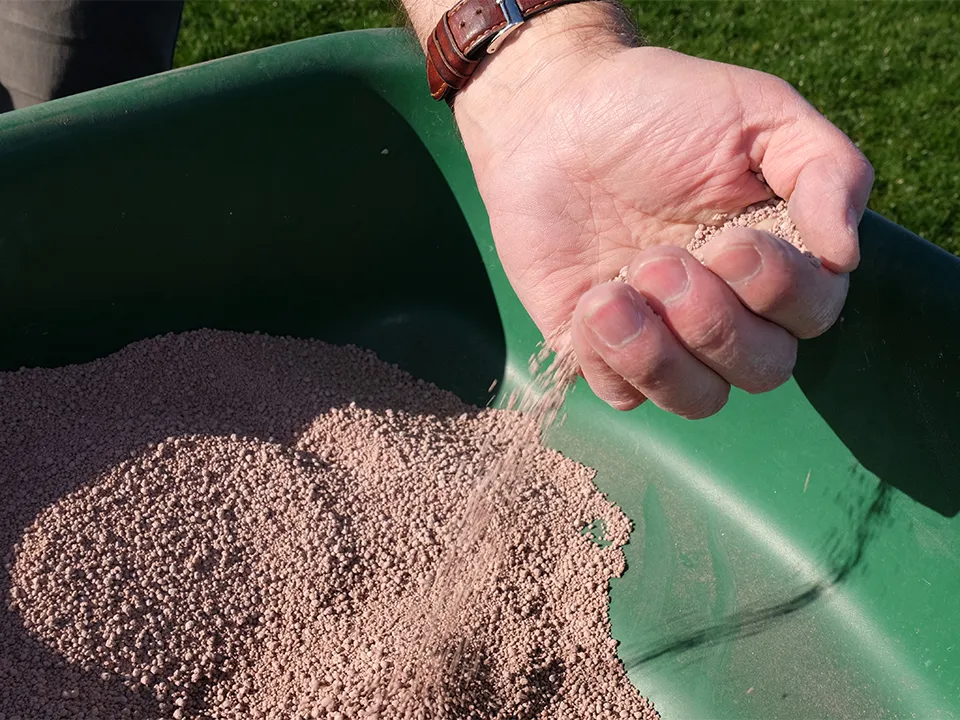
The product has a granular structure. Application with a spreader
Potassium is also a challenging element to manage in fertilisation. Since it is barely incorporated into the organic structures of plants, only limited amounts are present in the soil, mainly in the form of highly soluble salts. This means that potassium is relatively prone to leaching. Regular applications of potassium are therefore recommended, but in limited quantities.
Seasonal requirements
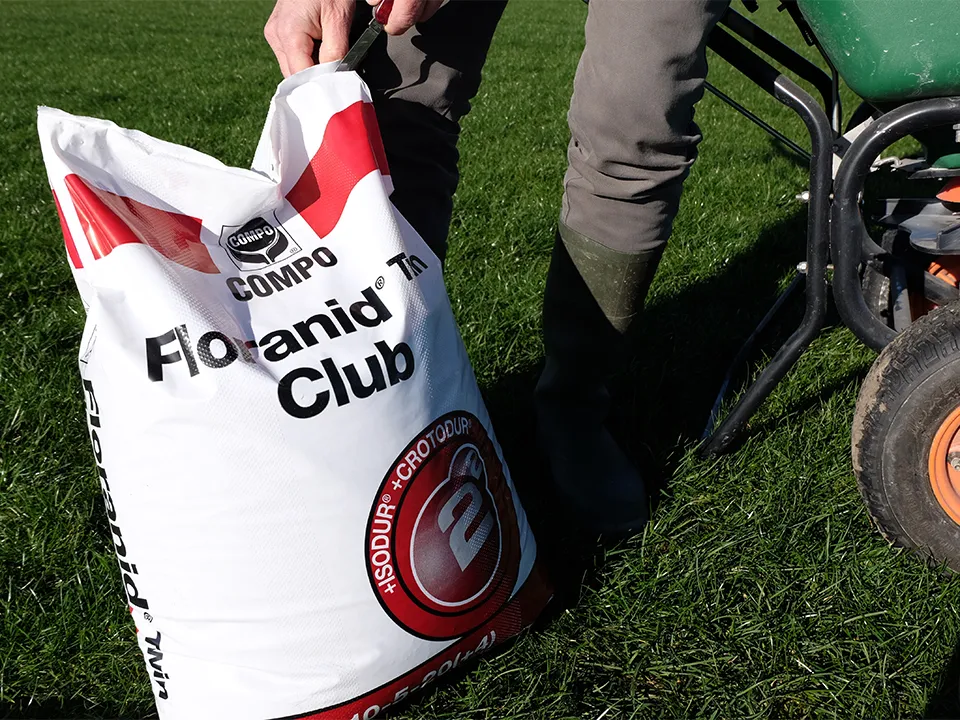
Bear in mind that the potassium requirements of grasses, and most plant species, vary with the season. For grass fertilisation, for example, a fertiliser with an N:K ratio of 2:1 is recommended from March to May. Floranid® Twin Turf 20-5-8 is particularly suitable for this purpose, not least because some of the nitrogen in the product is slow-release. From May to August, an N:K ratio of 1:1 is recommended. We recommend Floranid® Twin Permanent 16-7-15, which also contains some slow-release nitrogen. During prolonged dry conditions, it may be advisable to aim for an N:K ratio of 1:2 or even 1:3. From early autumn, the balance shifts decisively towards potassium, and an N:K ratio of 1:2 or even 1:4 is preferable. Floranid® Twin Club is ideal for applications of this kind, thanks to its 10-5-20 formula, with 60 % of its nitrogen in slow-release form. That gives an N:K ratio of 1:2!
If you need to aim for an even lower N:K ratio, and therefore apply more potassium in relation to nitrogen, as indicated by the results of a soil sample analysis, you can apply extra potassium sulphate in the latter part of the season, for example in November. However, standard potassium sulphate has a rather coarse granule size for this type of application. The very fine-grained potassium sulphate KALI GAZON (27 % K2O and 10 % MgO, particle size: 90 % between 0.5-2.0 mm) from COMPO EXPERT is therefore highly recommended. In dry summer conditions, it may be advisable to apply KALI GAZON at that time too, precisely because potassium prevents drought stress and subsequently helps the
turf recover more effectively.
Question about this story? Ask your question
Companies in this story

Keep following this
Get an email when a new story is published. No account needed.
- ThemeKeeping turf strong and playable
- SubjectGeneral
- CompanyCompo Expert







