









The right care makes for strong plants: How to get bay laurels through winter unscathed

Alongside their evergreen nature and the many options for topiary and sizing, durability and strength are often decisive factors when choosing bay laurels.
Even strong plants need the right care, however. What’s more, winter is when the foundations are laid for plants and trees to thrive for the rest of the year.
Bay laurel is an exceptionally strong, evergreen plant that can in principle remain outdoors well into autumn. However, it is not fully hardy in our climate. While it can withstand light, brief frosts of around -5°C without problems, prolonged frost will cause it to dry out or damage its trunk or crown. Topiary plants in particular can lose their aesthetic appeal as a result. As soon as severe frost sets in, or temperatures stay below freezing for several days, action is needed. There are two options: either overwinter the plant indoors, or wrap it in suitable materials.

Overwintering indoors
Where possible, it is advisable to bring bay laurels indoors to overwinter as soon as the first prolonged frosts arrive. Temperature, light, air and water are the main factors to consider.
When it comes to temperature, the principle is that ‘cold makes plants strong’. Plants do not need to be kept in a heated room, but should overwinter somewhere as close as possible to the outdoor temperature while remaining reliably frost-free.
Light is not essential during winter, when the plant is dormant. Plants can therefore also overwinter in a garage, garden shed or dark warehouse.
Regular ventilation, on the other hand, is essential, particularly to prevent diseases and pests.
Finally, bay laurel also needs water in winter. Plants overwintering indoors are entirely dependent on being watered by hand. As a rule, watering every two to three weeks is recommended, although the exact frequency depends on the temperature and amount of light.
Or should you wrap it up warm?
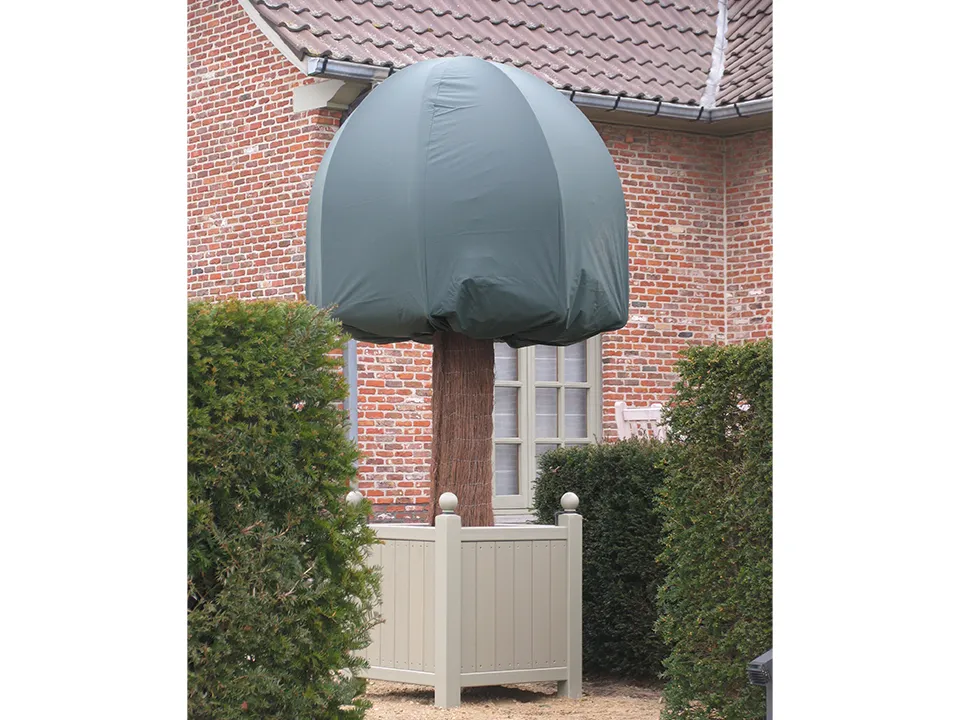
If no indoor space is available, or the plants are too large to move, bay laurels can also be wrapped up. However, this method requires a little more attention and can never offer a 100 per cent guarantee in prolonged frosts.
To protect the plant from frost as effectively as possible, the crown and trunk must be insulated, as well as the root ball. One option is to wrap the pot and spread a layer of straw over the potting soil. If the root ball is not adequately protected, the water in the soil will freeze and the plant will eventually dry out.
Although thorough wrapping is essential to protect the plant from frost, it also carries some risks. Moisture can build up beneath the covering, causing mould to develop. It is therefore important not only to use breathable materials such as jute or fleece, but also to ensure that plants are not left wrapped for any longer than absolutely necessary. In other words, if milder weather is forecast after a week of frost, it is best to unwrap the plant. When nights are frosty but days are fine, it may be enough to open the covering during the day to let the plant air.
Off-site overwintering
Unlike overwintering indoors, wrapping plants up offers less certainty and requires more intervention, as well as closer attention to the weather. For this reason, Laurica-Plants offers customers with project plants and private individuals the option of having their plants overwintered at the Lauretum in Jabbeke.
Ready for spring
Once the period of the heaviest night frosts has passed, usually in March, plants can be put back outside. Plants that are still fully dormant and are brought outdoors early will tolerate the cold better. By contrast, keeping them indoors for too long or in temperatures that are too warm will cause them to come into growth too early.
Ideally, bay laurels should be given a topiary trim during their winter dormancy, followed by another application of fertiliser just before spring, so they have enough nutrients to produce fresh, attractive green foliage.
Vraag over dit verhaal? Stel je vraag
Bedrijven in dit verhaal

Blijf dit volgen
Bij een nieuw verhaal krijg je een e-mail. Geen account nodig.
- OnderwerpGeneral
- BedrijfLaurica Plants







