









The 6 new living environments for a green and healthy setting
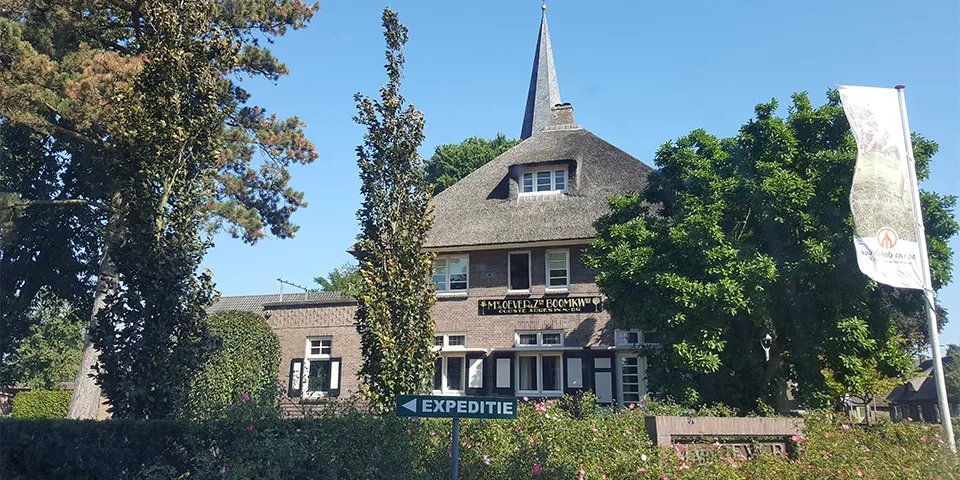
It was not so long ago that many businesses were purely product-oriented. Today, however, environmental challenges are framed so holistically that it is almost impossible to separate specialist product knowledge from green consultancy. “This means we need to think from the outset about placement, space and purpose, so we can achieve the best possible results for both usability and green quality in a living environment,” says Marwin Dekkers, Managing Director of nursery and green consultancy M. van den Oever.
“Ten years ago and before that, we were mainly focused on creating aesthetic value: what kind of look did we want to create? That has long since changed. Healthy neighbourhoods, climate-resilient neighbourhoods and active neighbourhoods are now the order of the day. But there is still much to do.” As Managing Director of M. van den Oever, a company that has specialised in green consultancy for almost 230 years, Dekkers is committed to creating healthy living environments throughout Belgium, the Netherlands and Europe.
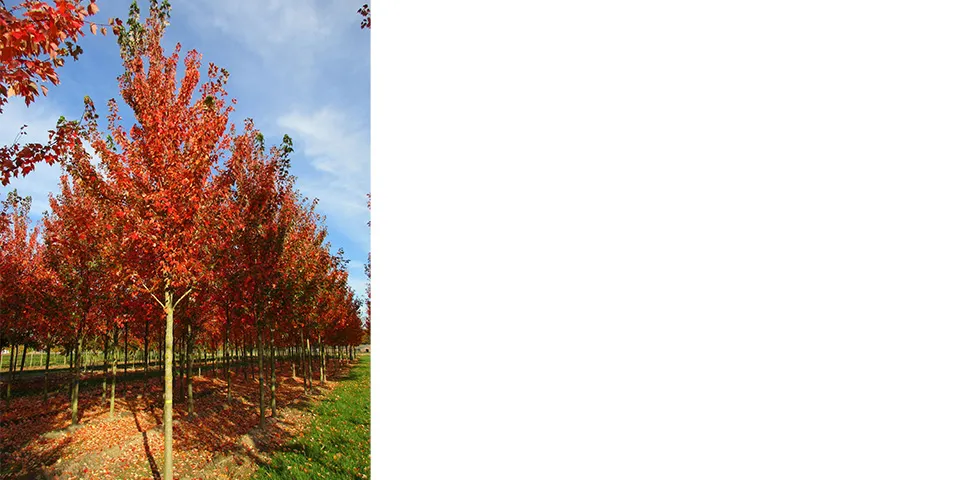
ColourSpace™ Acer Rubrum Franksred in autumn colours.
5 environmental challenges for green spaces
That is easier said than done, with one urgent issue after another emerging. The company has therefore identified five green pillars, or green environmental challenges, which highlight the importance of green spaces:
• Climate, because green spaces make an area more climate-resilient through measures such as water storage, water infiltration and drought-tolerant plants.
• Wellbeing, because green spaces draw both young and old outdoors, encourage physical activity and social interaction, and have a positive effect on health.
• The economy, because users place a higher value on greener environments, which in turn boosts property values and economic spending.
• Biodiversity, because green spaces enhance the experience of an area, provide food and shelter for people and animals, attract more bees, insects and birds, and reduce soil drying.
• Future-proofing, because green spaces planted today must remain in place for at least two to three generations to make the best possible contribution to the other pillars. This is also much more sustainable than designing for circularity.
Dekkers has more to say about the economic pillar: “User surveys show that the quality of an area is determined at least 45% by the greenery present, including green façades, with figures reaching as high as 75%. That is enormous. Yet when investing in a new square or park, barely one or two per cent is spent on greenery, or left over for it, I should say. Something is going seriously wrong in the way we design and deliver projects!”
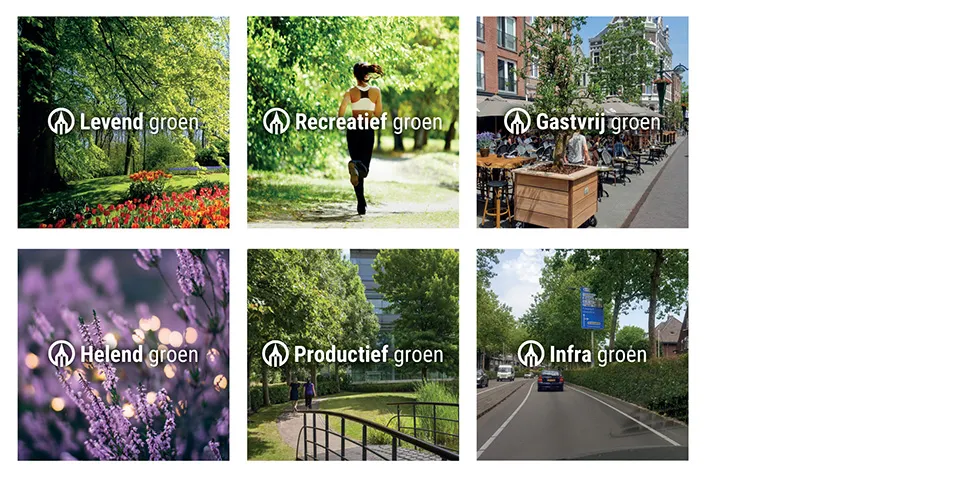
The 6 new GreenLife™ living environments.
6 new living environments for the future
M. van den Oever has translated these pillars into six typical, user-focused environments. They can serve as a guide to shaping and designing an area for a specific, tangible purpose. Green solutions have been defined for each environment to optimise its function. “The beauty of it is that each type of environment is often connected to the others in some way. That lets you combine objectives,” says Dekkers.
Living greenery
Also known as: every opportunity to green spaces smaller than 400 m2. “Along roads or cycle paths, outside buildings, in neighbourhoods: there are so many opportunities in places that are currently asphalted or paved. Here, you should always use our three-layer approach, for example combining different types of grasses or flower mixes with shrubs and trees, and mowing less to encourage biodiversity.”
Recreational greenery
Small and large parks for recreation, socialising and events. “And we’d like to go on strike there one day too,” Dekkers jokes. “Recreational green spaces should above all encourage children to play and older people to relax, for example by adding water, while also taking animals and ecological corridors into account.”
Welcoming greenery
Greenery that invites people to spend time there, while also increasing the value of surrounding amenities and encouraging recreation and spending. “So this is the opposite of a concrete shopping street or ‘quickly added Christmas lights’. Add quality to enhance the experience. Take Efteling or Plopsa: these parks would not have become such huge successes if the greenery had not been considered so carefully as part of the overall design.”
Healing greenery
Learning, relaxing, healing. “Green spaces serve all these purposes through knowledge of species that stimulate, engage and relax. For example, the Common Walnut (Juglans regia) is a tree that can provide year-round benefits in settings such as healthcare facilities: it is a highly effective filter for solar radiation, provides immediate cooling equivalent to 10 air conditioners, and offers walnuts to enjoy throughout the year, which also help repel mosquitoes when in season.”
Productive greenery
Views of greenery give people the relaxation they need at work and reduce sickness absence, while green spaces also increase rental and property values. “Greenery in a business park encourages employees to eat outdoors or go for a walk. It also creates opportunities to add an exercise bench or fitness equipment to encourage physical activity. Well-designed business parks have no trouble attracting new employees.”
Infrastructure greenery
Greenery that supports our climate, for example by capturing fine particles and allowing water to infiltrate. “We’re very glad that wealthy people in the Golden Age came up with the idea of planting trees along the canals for the ‘cieraet ende plaisantie’ of the streetscape. They are doing a lot of good now. Armies also needed protection from the elements during the wars, which is where much of our current infrastructure greenery originates. Today, we are making greater use of it to make the environment more biodiverse and climate-resilient.”
FREE Greening booklet and presentation
Dekkers will present the method for greening the six living environments, along with specific green solutions such as ClimateTrees™, PlayGreen™, EatMe™, BirdTrees™, ColourSpace™ and more, in a keynote presentation at De Dag van de Openbare Ruimte in Brussels on 6 February 2020. M. van den Oever will of course also be exhibiting.
You can now request this presentation and a beautiful FREE copy of the book ‘Prettige Plekken’, which explores green quality and usability through images from across Europe, via the link www.vergroen.nu!
Haaren in North Brabant: Europe’s green nursery
Since 1791, tree nursery M. van den Oever in Haaren, North Brabant, has been one of the largest nurseries, located on ideal loamy sandy soil and leading the way in sustainable cultivation and green consultancy in the Netherlands and beyond. It works with around fifty quality-selected green suppliers in the region.
This approach produces healthier, stronger plants and trees for its customers, as well as a complete green assortment of 12,000 species, with support provided right through to the client’s project.
The nursery supplies European cities and municipalities, landscaping companies, water boards and construction companies in Belgium, France, Germany, Denmark, Sweden, England, Austria and Switzerland. Haaren proudly fulfils its role as a sustainable nursery for green Europe.
Question about this story? Ask your question
Keep following this
Get an email when a new story is published. No account needed.
- SubjectGeneral







