









PODCAST: Building a global sports turf community in an era of high stadium pressure
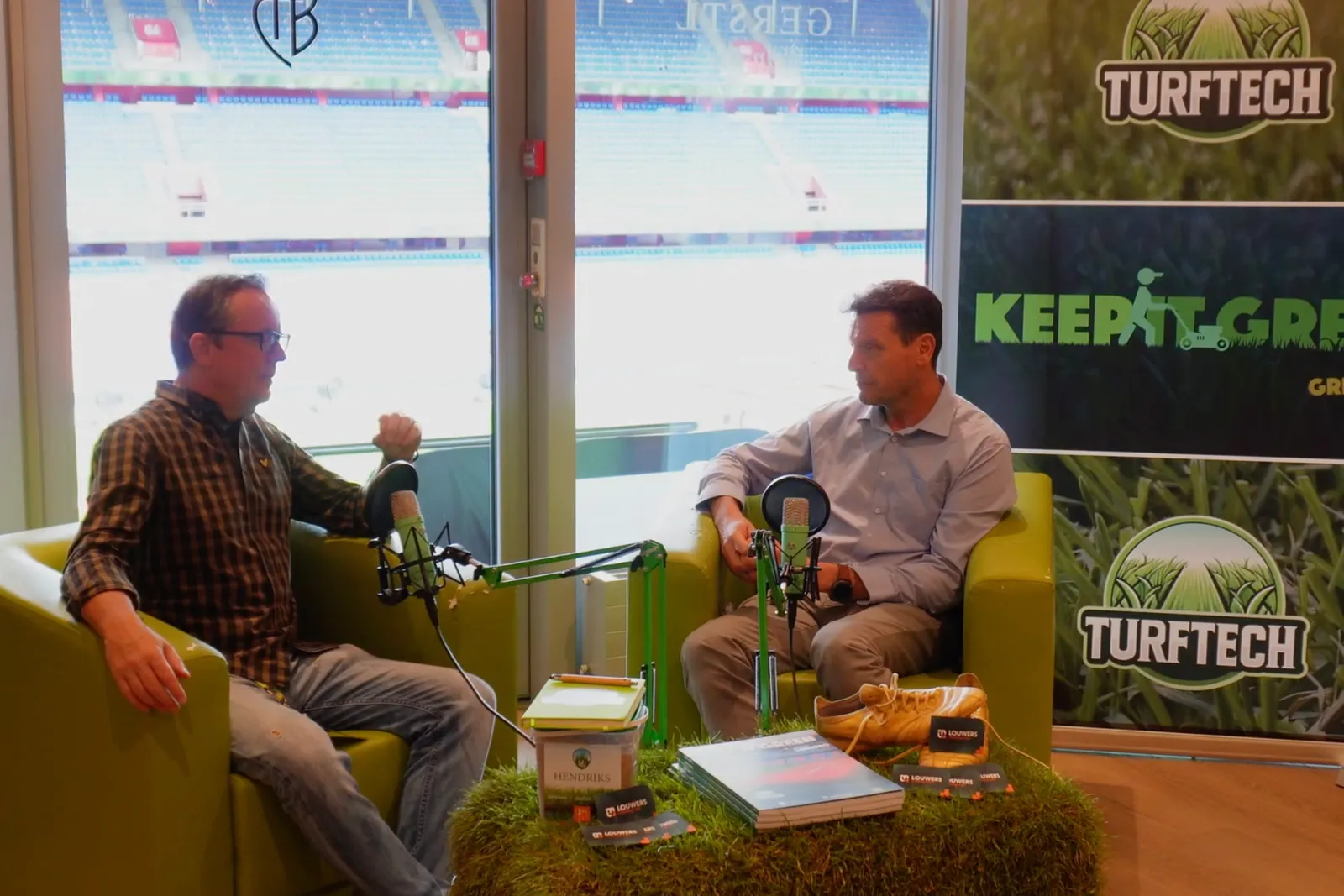
At TurfTech 2025 in Basel, we spoke to David Roberts, founder of the International Sports Turf Managers Association (ISTMA) and one of the most experienced professionals in international sports turf management.
Spotify Embed: Building a global sports turf community in an era of high stadium pressure
Host: Kris Vandekerckhove
Guest: David Roberts, Founder ISTMA
Podcast: Keep It Green, TurfTech 2025
With a career spanning several decades at top clubs such as Southampton FC and Olympique de Marseille, David has worked in the UK and across Europe, witnessing first-hand the evolution of modern stadium operations. From traditional 12-week renovation periods to today’s one-week turnaround between concerts and league matches, he has seen how managing multi-purpose stadiums at the highest level has become increasingly complex.
In this episode, we discuss:
- The origins and mission of ISTMA, and why global knowledge-sharing is essential to the future of the profession;
- Cultural differences between the UK and the European sports turf industry, particularly in communication and collaboration;
- The pressures of modern stadium management in multi-purpose venues with minimal recovery time;
- The rise of data-driven young professionals and how technology is changing sports turf management;
- The concept of the “accidental manager” and the leadership challenges facing recently promoted grounds professionals;
- The importance of resilience, networking and industry-wide support systems.
An open conversation about mentoring, communication, work-life balance and the shared responsibility to strengthen the international sports turf sector and make it fit for the future.
Question about this story? Ask your question
Full transcript
Alle hoofdstukken (12)
- David Roberts on his role
- The origins of ISTMA
- The younger generation and the accidental manager
- Modern stadiums as multi-purpose venues
- Weather, quality and expectations
- Problem-solving around the world
- The data-driven younger generation
- The pitch as your baby
- The future and ISTMA
- First stadium experience and support from the industry
- Knowledge-sharing versus competition
- Reflections on the event
David Roberts on his role
David Roberts I’m just a groundsman who’s been fortunate enough to work at some incredible venues with great teams.
The origins of ISTMA
Kris Vandekerckhove Yes, yes. I’d like to talk a bit about ISTMA. Yes, ISTMA, or IS(T)MA, however you want to pronounce it. It was, oh yes, we’ll call it that, it’s actually easier. Yes, okay.
David Roberts It grew out of a conversation a few years ago. The conversation was with Dean Gilasbey. Dean was a groundsman in the UK and worked overseas as a consultant. I’d just left Liverpool and was living in Portugal, doing some consultancy and advisory work. We were simply comparing our experiences of working outside the UK to see what it was like.
David Roberts One thing is that we’re actually spoilt in the UK, because we have so many good trade shows. The GMA represents grounds managers and BIGGA represents greenkeepers, and lots of people get involved and share knowledge and experience. That was probably one of the biggest differences we noticed outside the UK.
David Roberts We talked about it: could we do something? We both felt we’d been in the industry a long time and had got a lot out of it. We wanted to give something back. How could we do that? I didn’t want to recreate the GMA. I wanted to do something that belonged to us, not us personally, but all of us, all grounds managers, the sports turf community, built from the ground up. People need to be involved.
David Roberts The main thing we noticed was the level of communication. Let me give you an example. In the UK, if I had a problem when I was working at Southampton Football Club, I could pick up the phone and call Steve Braddock, who was then working at Arsenal Football Club. “Steve, I’ve got a problem with the pitch. I had something similar last year. This is what I did. Give that a try.” Or I’d talk to someone else: “I want to try this product. I think you’ve used it, what do you think of it?” “Yes, yes, we use it at this rate and at this time of year.”
David Roberts So there was a huge exchange of knowledge and experience, helping each other, camaraderie. It happens in Europe too, but very slowly. We thought it would be good to encourage that and find a way for people to communicate, share ideas and knowledge, and support each other. That’s the idea behind ISTMA.
David Roberts International Sports Turf Managers Association.
Read the full transcriptCollapse transcriptnog 10 hoofdstukken
The younger generation and the accidental manager
Kris Vandekerckhove I think it could be perfect for the younger generation, so that all the knowledge you and your staff have built up can be shared with young people. The people at Manchester City I spoke to are 25 or 26 years old.
David Roberts They can’t yet have the experience or knowledge you’ve gained. I often use the term accidental manager. I’ve seen it so many times in the UK and other countries: if you’re really good as a groundsman and produce a good-quality pitch, you get promoted to manager. But often you don’t get the support you need. Suddenly you go from being someone who’s good at pitch maintenance to someone who has to deal with board members, head coaches and medical teams. That level of communication can create enormous pressure.
David Roberts Some people then leave the industry. When they leave, the assistant steps up and the learning process starts all over again. That’s why it’s important to support people and help them with the problems they face.
Modern stadiums as multi-purpose venues
Kris Vandekerckhove Impressive. And you also talked about communicating with different levels of stakeholders.
David Roberts Yes.
Kris Vandekerckhove Things are different today. And it’s no longer just about football on the main pitches.
David Roberts Many stadiums today are multi-venue, multi-purpose. You have to think completely differently. When I started at Southampton Football Club, we had 12 weeks in the summer to renovate, seed and get the pitch strong enough for the season. When I worked at Olympique de Marseille, as soon as the season ended the pitch came out and the concert floor went down. The first concert was the following week, then one concert after another all summer. After the last concert, you have one week to lay new turf, stitch it in, mark the pitch and play the first match. That shift from 12 weeks to one week is, well, frightening.
Weather, quality and expectations
Kris Vandekerckhove Yes, it’s frightening. It’s a very short window, and you have to manage not just the pitch but also the weather.
David Roberts What if it pours with rain that week or it’s 38 degrees? It’s a real challenge, and you lose some control over the quality of the material that comes in, whereas with seeding you can control that quality more. You also have to manage expectations, because teams expect a perfect pitch. And if it’s not 100 per cent perfect but 95 per cent, and they don’t play well
Kris Vandekerckhove Then it’s your fault.
David Roberts Yes, yes.
Problem-solving around the world
Kris Vandekerckhove What’s one thing you’ve learned from working around the world that you still use today?
David Roberts It’s hard to name just one thing. What I really appreciate is how good groundsmen and sports turf managers are at solving problems. Wherever I go, I ask: what’s your biggest challenge? Then they explain how they tackle it. It’s impressive.
David Roberts: It could be the climate. It could be the budget. It could be pests. Or diseases. It could be a lack of renovation time or insufficient support. There are so many factors. We’re very resilient as sports turf managers. We have to be. What I’ve really taken away is how strong and resilient our industry is.
The data-driven younger generation
Kris Vandekerckhove Am I wrong to think that the younger generation is finding its way in the profession? It’s a 24/7 job. Very stressful.
David Roberts I think the strength of the younger generation lies in its data-driven approach. Traditional groundsmen relied more on experience and observation. Younger professionals work much more with data.
Kris Vandekerckhove I spoke to someone at the Arena, aged 26 or 27. He’s installed cameras to monitor the grass. And I’m serious. He watches it at home. He wants to know everything. He’s obsessed with the grass and the soil. And he’s only 26 or 27. It’s amazing.
The pitch as your baby
David Roberts The danger in our industry is that the pitch becomes your master. We call the pitch our baby. “How’s the baby?” It almost becomes more important than your own family. It’s very difficult to find a good work-life balance. You need to be able to switch off and make time for your partner and children. Often your baby, the pitch, becomes your priority. It doesn’t look right, it needs attention, so you go back to work.
Kris Vandekerckhove You have to do this. That’s what you told me. I think that’s so passionate.
David Roberts They’re all like that. Very, very passionate about their baby.
The future and ISTMA
David Roberts What does the future hold? I don’t know. I turned 60 this year, and at a time like this you look back and forward. I really want ISTMA to work. I want people to contribute their ideas. It shouldn’t be David Roberts’ idea, it should be an idea shared by all groundsmen. If there are challenges that aren’t being addressed, let’s talk to WSPA. Let’s work together to find solutions. And if there’s a problem I don’t know about, let people come to us so we can solve it together.
Kris Vandekerckhove Are you that approachable?
David Roberts I think so. I share my number and my email. I can’t solve everything, but we can talk about it.
Kris Vandekerckhove That also adds stress.
David Roberts Yes. But it’s important.
First stadium experience and support from the industry
David Roberts When I started in 1994, I worked for a contractor maintaining school pitches and pitches belonging to the Ministry of Defence. I’d never worked in a stadium. My first job at Southampton was straight in as the sole groundsman for a match against Arsenal. I’d never prepared a stadium pitch. The pressure was enormous. You have to deliver straight away. I called Steve Braddock at Arsenal. I didn’t know him. He said: “Come to Highbury, I’ll show you how we do it.” That sense of being a team is important. You can feel very isolated on your own at a pitch. Sharing problems helps you find solutions. It’s difficult on your own.
Knowledge-sharing versus competition
Kris Vandekerckhove There’s no competition between groundsmen in the UK.
David Roberts I’ve seen that on my travels. In many countries, clubs work with contractors. They have their own way of doing things and don’t want to share it with competitors. That creates a barrier to communication. In the UK, most grounds teams work directly for the club. Golf is different: members can switch clubs, so competition is greater. In football, fans keep coming. That means we can communicate openly. Pitches in France, Germany and Spain have improved significantly. The UK has made rapid progress through communication and knowledge-sharing.
Reflections on the event
Kris Vandekerckhove What will you take away from an event like this?
David Roberts You come together with like-minded people. You network, share experiences and meet old and new friends. You go home with a smile. Florian has done a great job.
Kris Vandekerckhove That’s right. Will you see him in the UK next year?
David Roberts Definitely. Absolutely.
Kris Vandekerckhove I recommend that everyone come to TurfTech. Thanks, David.
David Roberts It was an honour to talk to you. Thank you for taking the time.
Keep following this
Get an email when a new story is published. No account needed.
- ThemeSports pitches under heavy use
- SubjectGeneral







