









PDPO project brings together practical examples from East Flanders
With the changing climate and successive periods of water scarcity and excess water, it can sometimes be difficult to maintain the quality and functionality of green spaces. The PDPO project ‘Efficient water management with green spaces’ addresses this challenge. Using developed demonstration green spaces in East Flanders, it aims to bring together and share knowledge and practical examples of efficient water management.
Efficient water management with green spaces
Words Eva Reybroeck & Jesse Tavernier | Images PCS
The extreme weather conditions of recent years have not gone unnoticed. Since records began, the rainfall deficit in the run-up to summer has never been so severe, and for the fourth year in a row we have experienced exceptional drought in recent months. The winter months, by contrast, are becoming increasingly wet, leading to seasonal flooding. Trees and plants are suffering as a result.
However, choosing drought-tolerant plants and efficient water management techniques when creating and maintaining green spaces can help make them climate-resilient. PCS is investigating and demonstrating the possibilities in three municipalities in East Flanders, and this article discusses the initial results.
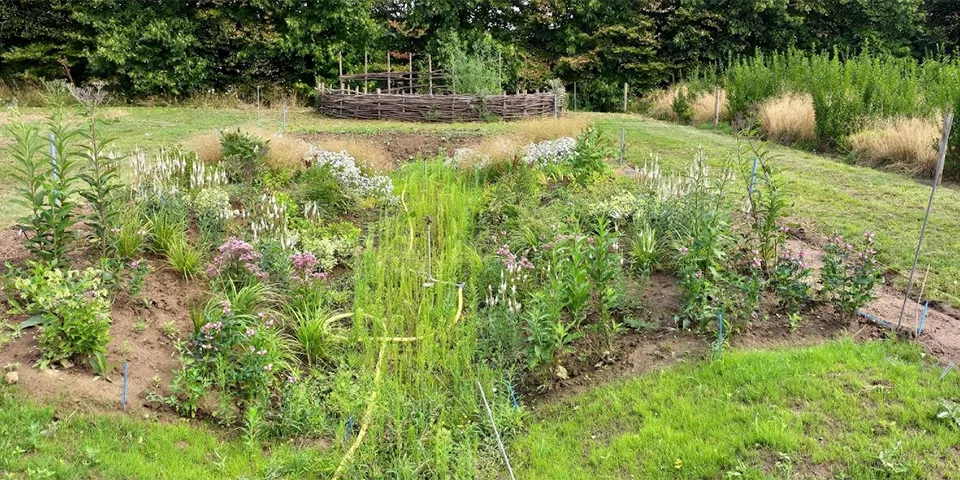
A wadi planted with various vegetation types was created at PCS.
Demonstration projects
Last spring, three demonstration areas were established in Oudenaarde, Dendermonde and Aalter. Various soil preparation and improvement techniques were applied, and the use of cover materials and anti-transpirants is also being demonstrated. PCS is also testing different planting types for a wadi.
PCS regularly monitors the different green spaces. Plant quality (including plant losses, flowering, growth and stress indicators) is assessed, and soil moisture is measured. The municipalities, in turn, record how often the plantings need watering.
Improved flowering and growth
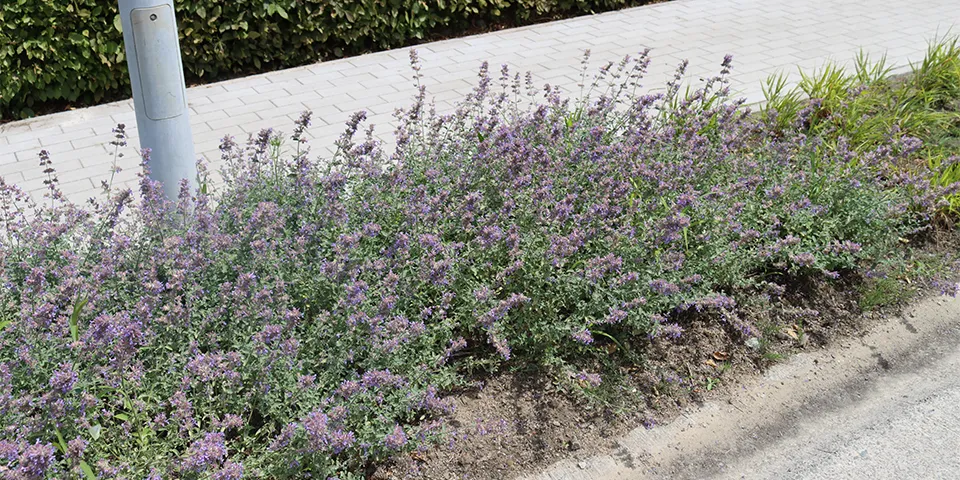
In Dendermonde, Hagewijkpark was planted with a range of shrubs: Berberis, Symphoricarpos, Hydrangea, Hypericum, Spiraea, Rudbeckia and Nepeta. Various soil amendments were used at planting (compost, bentonite granules, water polymers and a combination of all three), and compared with untreated soil. The amendments help the soil retain water, creating a water buffer in the planting beds and reducing the need for frequent watering. Compost and the combination of soil amendments have already been shown to improve flowering and growth in Nepeta.
Higher soil moisture
Roses were planted in eight green spaces in Oudenaarde, where the products Karisol, Oenosan and TerraCottem are being tested. Karisol is an organic soil improver that increases the organic matter content of the soil and promotes better plant growth; Oenosan is a natural lime fertiliser that activates the plant’s defences; and TerraCottem is a physical soil improver which, thanks to its biostimulants and water polymers, also increases resistance to drought stress. Compared with the control, all these products increased soil moisture, although it remains to be seen whether the green spaces will consequently need less water in practice.
Container mulch was also applied as a ground cover to half of the planting beds. This resulted in soil moisture levels 17,8 % higher than in green spaces without container mulch.
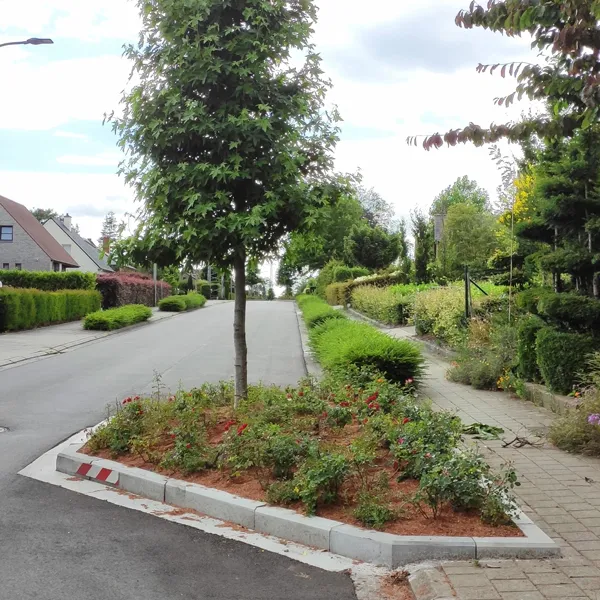
Container mulch was applied to the planting beds in Oudenaarde, with a clear impact on soil moisture.
Greater biodiversity in wadis
With weather conditions becoming increasingly extreme, it is also necessary to reduce pressure on our sewers and maintain groundwater levels, for example by creating wadis and infiltration basins. Rather than planting these basins with a uniform, monotonous grass mix, as is usually done, two wadis have been created on the PCS grounds to demonstrate alternative planting schemes.
The first wadi demonstrates two substrate types: a sandy substrate and a clay substrate. Both were planted with vegetation suited to the conditions and highly tolerant of fluctuating moisture levels. Using the Iersel system, the water level in the wadi can be adjusted artificially to create both wet and dry conditions, allowing the plantings to be monitored effectively.
The second wadi is being used to demonstrate different types of natural vegetation: natural vegetation managed by mowing, an area with natural herb and flower mixes, and an area with native shrubs.
Have your say!
To help develop the project further, PCS is seeking feedback from the sector. Which water management techniques are already being used? What has your experience been? What effect do prolonged periods of drought have on the creation and management of green spaces? Do you know of any inspiring examples of water-efficient designs?
Research supported by the Flemish Government, the Agency for Innovation and Entrepreneurship, the European Union, the Province of East Flanders, Boerenbond and AVBS, the ornamental horticulture and green sector federation.
Question about this story? Ask your question
Keep following this
Get an email when a new story is published. No account needed.
- SubjectGeneral







