









Hugo Maes, an expert grower of holm oak and kermes oak
Hugo Maes, a renowned perennial plant grower from Waregem, loves spending time in nature.
From chance discovery to core business
About ten years ago, while walking through a woodland at altitude in the south, he became intrigued by acorns from Quercus ilex (holm oak) and Quercus coccifera (kermes oak) scattered across the ground. He decided to take them home and try growing them. Today, the project is his core business.
Words Philip Doutreligne | Photography Hugo Maes
Carefully cultivated
He still travels abroad every year to collect acorns. The plants already planted in our country are still too young to bear fruit themselves. He also uses only acorns from plants with small leaves. This allows them to be clipped neatly and form a dense canopy.
The young plants adapt effortlessly to our climate. They are regularly potted on into progressively larger containers until they reach the desired size. Maes’ current range of Quercus ilex is available in sizes from 30/40 cm to 100/125 cm. The site where he carefully grows the young plants now covers more than a hectare, but is in urgent need of expansion.
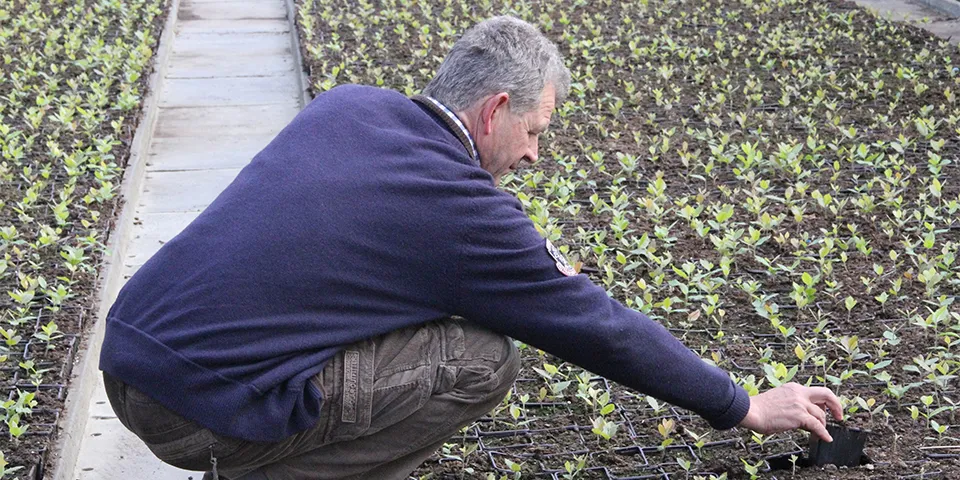
Hugo Maes checks some young cuttings being grown on.
Attractive and evergreen
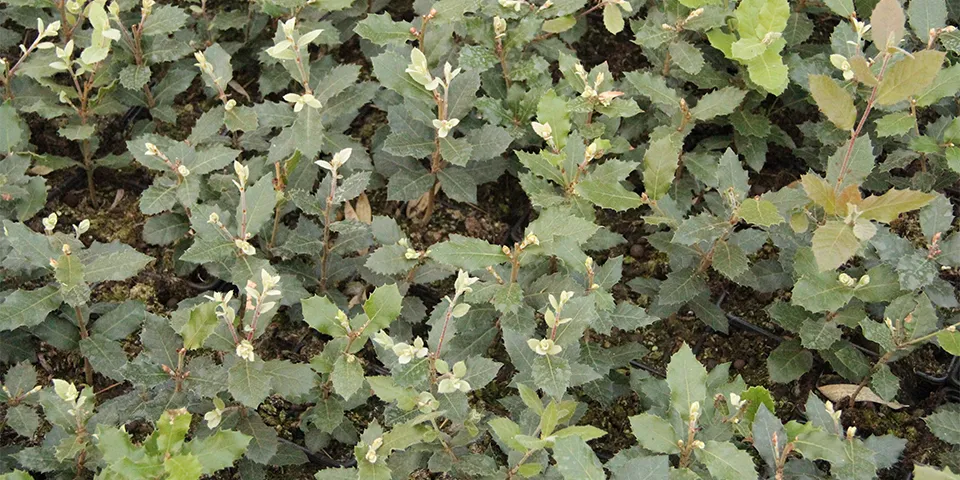
Quercus ilex is a particularly attractive plant, with smooth or serrated, leathery, dark green leaves. The undersides of the leaves are silvery grey. In May and June, holm oak produces an abundance of pale yellow flowers. The plant withstands even the harshest winters without difficulty and remains largely evergreen.
A plant for the future
Quercus ilex is sure to grow in popularity. It is resistant to diseases and insects, and can tolerate extreme heat and drought once well established. Kermes oak can even grow in gravelly soil. With temperatures rising and heatwaves becoming increasingly common in our region, Quercus ilex and Quercus coccifera offer promising prospects. Kermes oak is also an ideal alternative to box, which is increasingly attacked by box tree moth. Its small leaves mean it can be clipped into an equally attractive ball shape.
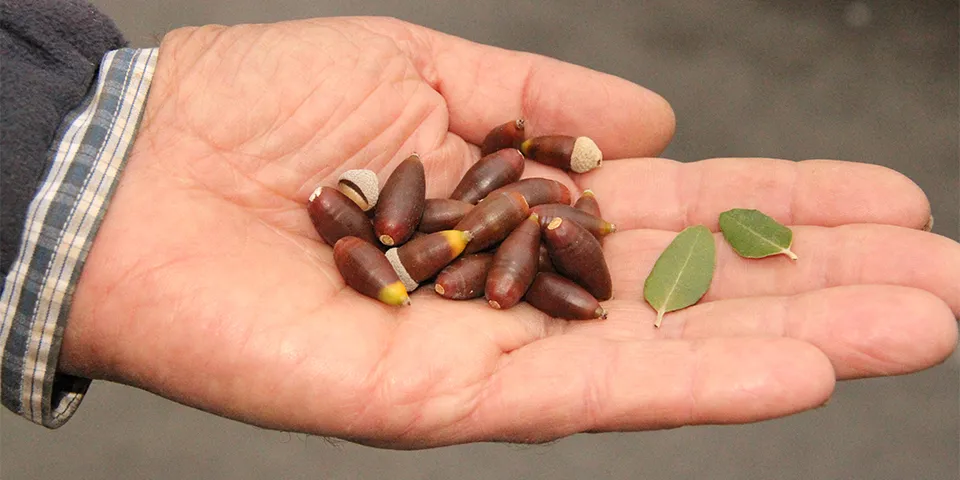
A selection of carefully chosen acorns.
For every type of planting
Holm oak is naturally a tree that can grow tall in its native habitat. However, pruning allows young plants to be kept perfectly in check, forming neat, compact, continuous hedges or looser shrubs. This makes them ideal for garden boundaries, creating garden rooms or as striking mass plantings. Two cuts a year, in April and September, are enough to maintain a neat hedge. Quercus coccifera is also ideal as ground cover.
Professional recognition
The pioneering work Hugo Maes has carried out is gradually bearing fruit, including among industry professionals. Many landscape contractors and garden designers are already using his plants in their own gardens. They are also increasingly specifying native Quercus in their designs instead of imported species, giving their clients confidence that the plants can cope with our changeable climate.
Also suited to large-scale projects
Quercus ilex and Quercus coccifera are not only suitable for private gardens, they are also increasingly being used in larger projects such as residential developments, apartment complexes and public buildings. Here, too, factors such as disease resistance, aesthetics, hardiness and low maintenance are decisive. Recent high-profile projects involving the planting of substantial numbers of holm and kermes oaks include ‘Duinenwater’ in Knokke and ‘Parkresidentie Ter Vichte Resort’ in Anzegem-Vichte.
Question about this story? Ask your question
Keep following this
Get an email when a new story is published. No account needed.
- SubjectGeneral







