









Green Department commits to pooling plant knowledge across Europe
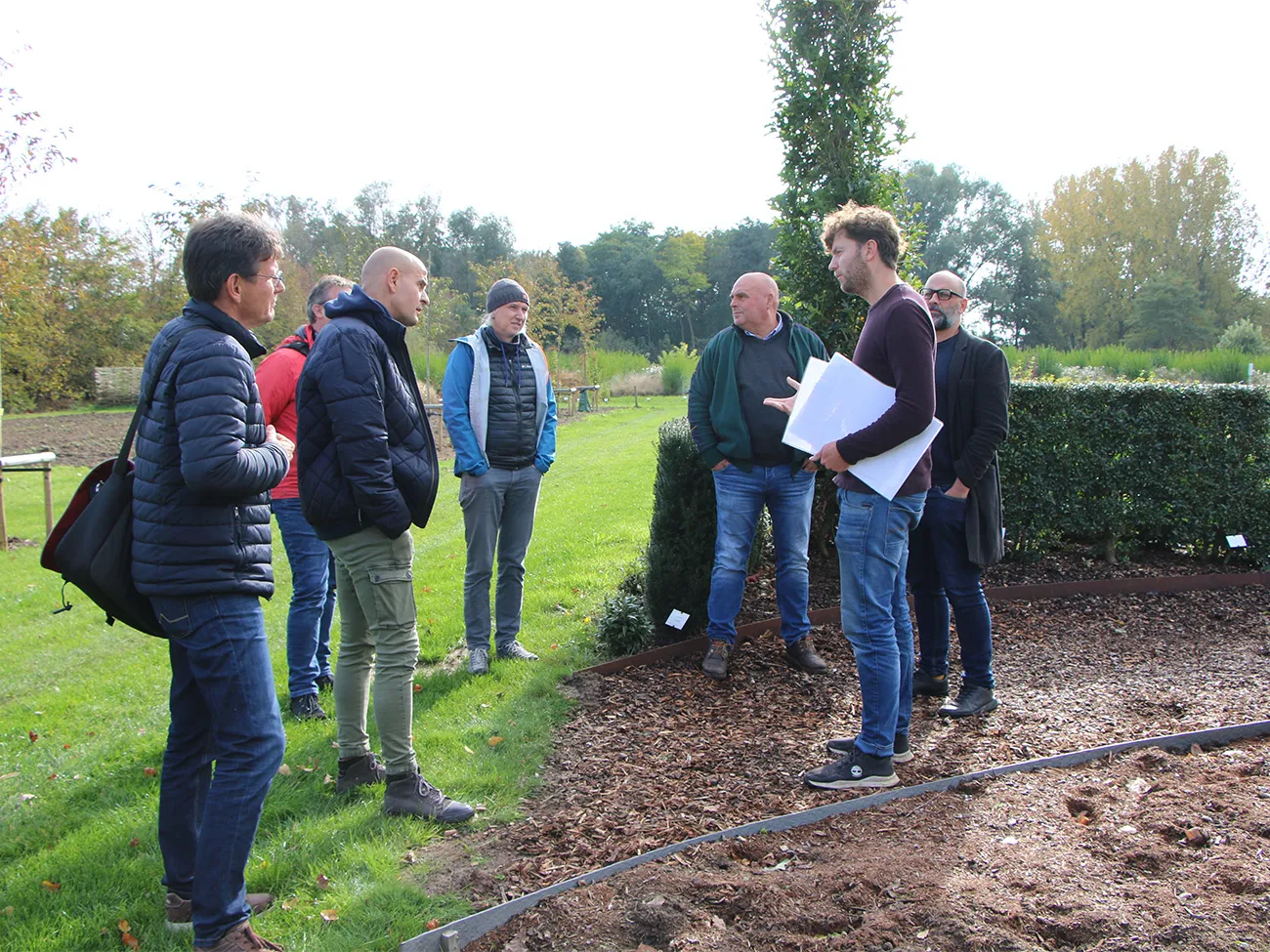
On 26 and 27 October last year, PCS hosted the annual Eurotrials meeting to evaluate and establish joint plant assortment trials at European level. The participating countries were Belgium, the Netherlands, Germany, England, Austria, France, Ireland, Finland and Iceland. As is traditional, following the annual meeting at PCS, participants visited a number of interesting plant collections and research sites.
PCS gave an overview of the assortment trials and demonstration gardens run by the Green Department and the Nursery Department, which focus on a range of applications. The following uses are being studied in practical trials to assess plant habit, tolerance to pests and diseases, and tolerance of certain climate extremes (drought, waterlogging and heat):
- evergreen topiary shrubs
- climbing plants for different façade orientations
- plants for infiltration zones (rain gardens)
- ground-covering perennials, shrubs and bedding plants in different light conditions
- climate-resilient trees
The trials on planting techniques (the use of soil improvers, soil additives to limit drought damage, and irrigation techniques when planting in soil) also highlighted the importance of getting the establishment phase right, alongside selecting the right plants.
The Eurotrials partners then enjoyed a tour of ILVO: Plant, led by Dr Johan Van Huylenbroeck. The visit provided an insight into the breeding research through which ILVO supports the ornamental horticulture sector, an approach unique in Europe. This expertise is further commercialised through the cooperative Best-select. The breeding programme has produced some outstanding successes, including Hydrangea paniculata ‘Pinky Winky’, which are distributed worldwide.
Overall, the research infrastructure supporting Flemish ornamental growers and green-space professionals was seen as highly stimulating and innovative. The collaboration and coordination between the various research centres through Technopool Sierteelt (PCS, ILVO, UGent and HoGent) is an excellent example of making efficient use of budgets to achieve maximum impact.
Arboretum Wespelaar
To provide further inspiration for the Eurotrials assortment research, participants also visited Arboretum Wespelaar, known for its collection with a wide palette of autumn colours, from genera including Liquidambar sp. & Nyssa sp., as well as less familiar species such as Lindera sp. The Arboretum has an extensive collection, often with an interesting story behind it. For example, it is home to several specimens of Franklinia alatamaha, a plant that stands out for its exceptional combination of red autumn foliage and white flowers (from September until the first frost). It is important to note that this species has become extremely rare in its natural habitat, and that this Arboretum, like other plant collections, helps to conserve this and other unusual species.
Hibiscus sp.
As part of this European collaboration, a two-year comparative trial of around 60 Hibiscus sp. cultivars was established at PCS in 2014. Its results remain valuable in helping growers make the right plant selection.
Hibiscus is a warmth-loving plant that waits patiently for summer, then grows vigorously and produces striking flowers well into autumn. Its distinctive flowers are available in various colours (mainly white, pink and blue), with either an open centre (large, prominent stigma and stamens) or a filled centre (semi-double or fully double flowers).
This plant is easy to maintain, with very little pest or disease pressure. It is also highly flexible when it comes to pruning: you can leave it unpruned, or cut it back each spring to a few framework branches to limit its height. As the plant flowers on one-year-old wood, pruning does not have a negative effect on flowering.
The comparative trial assessed relevant characteristics of the different cultivars in terms of growth, flowering and durability. Results varied according to planting location, but some cultivars performed well across the board. A full discussion of the results for Hibiscus, as well as for Physocarpus opulifolius, can be found in Dendroflora no. 56 (2020).
PCS is currently running a comparative trial of 42 low-growing Spiraea species and cultivars. The results are due at the end of 2022.
Question about this story? Ask your question
Keep following this
Get an email when a new story is published. No account needed.
- SubjectGeneral







