









Annuals and perennials as ground cover beneath naturalistic planting
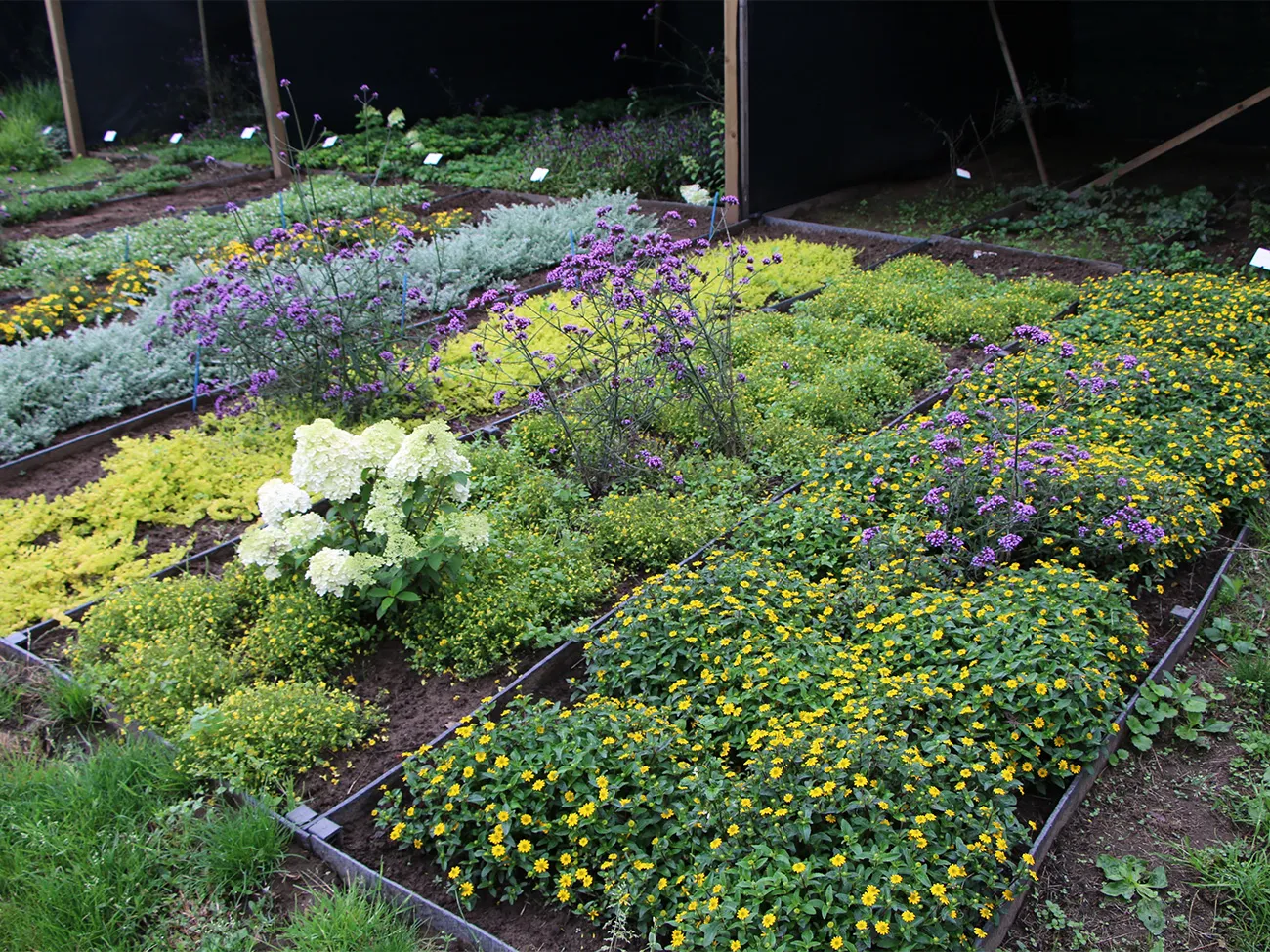
At the Ornamental Plant Research Centre, a range of ground-covering perennials was trialled in different light conditions, alongside annuals and ground-covering shrubs. This article presents the findings after two years.
In naturalistic planting, ground-covering plants form the lowest layer, with a fringe layer of shrubs above, followed by a shrub layer and a tree layer. In gardens and public green spaces, they are also often used as block planting, with or without one or more of the other natural layers. They cover otherwise bare soil, helping to reduce weed pressure and slow the drying of the soil through evaporation. However, a limited number of familiar species are often chosen, and these are not always suitable for every condition.
Ground-covering perennials in different light conditions
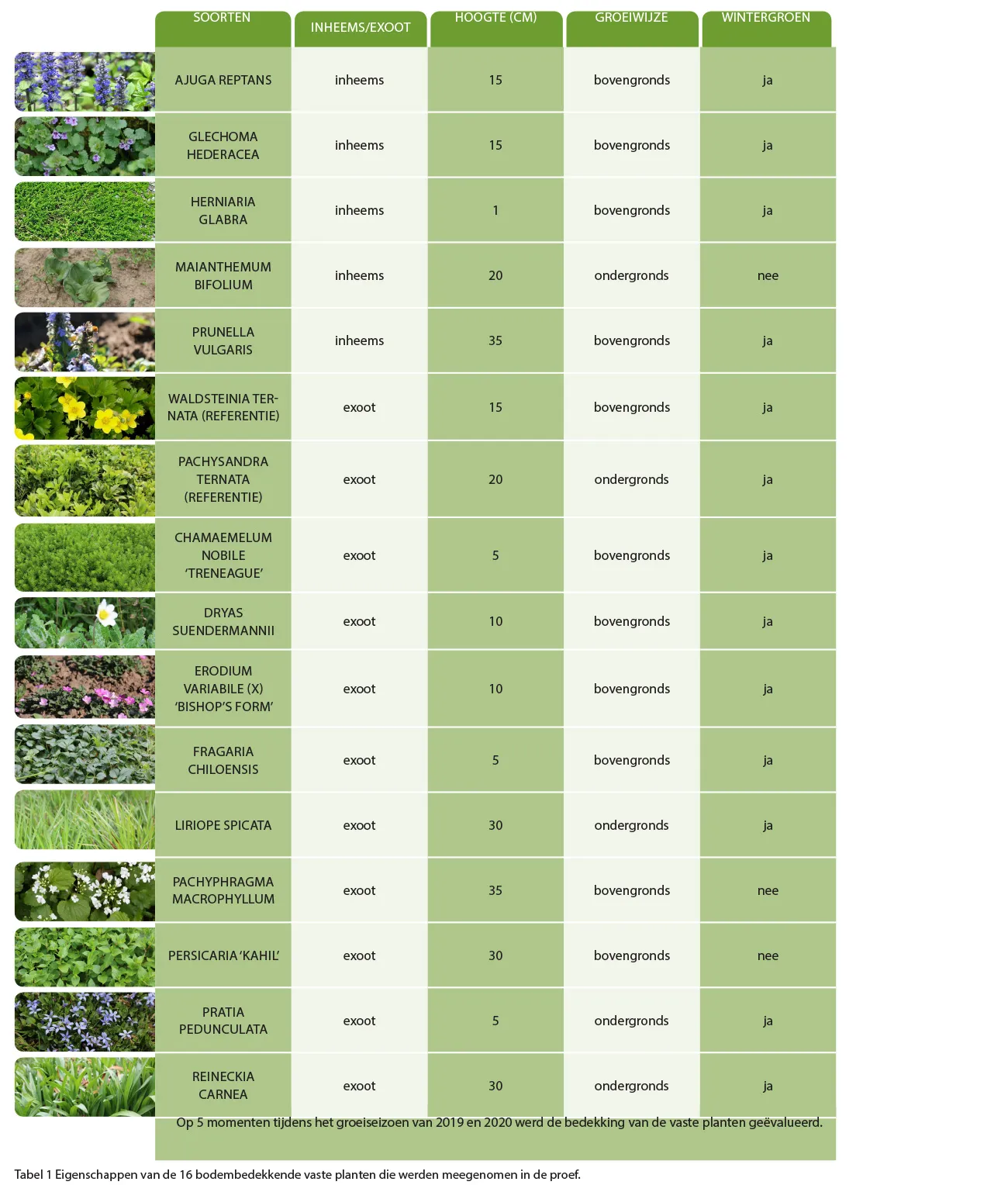
In 2019, a trial was set up with a selection of sixteen ground-covering plants, each planted in sunny, partially shaded and shaded conditions. The species were selected based on leaf shape, growth habit (underground versus above-ground runners), evergreen characteristics and origin (native/non-native). Associations with a shrub (Hydrangea paniculata ‘Bobo’), a bulb (Narcissus poeticus and Crocus vernus ‘Remembrance’) and an upright perennial (Verbena bonariensis) were also assessed. The selection included reference species such as Waldsteinia ternata and Pachysandra ternata, as well as less familiar species such as Reineckia carnea.
Erodium and Maianthemum had low ground cover in all light conditions. By contrast, Fragaria, Prunella, Reineckia, Liriope spicata and Persicaria performed well in sunny, partially shaded and shaded conditions. Species such as Ajuga, Dryas, Glechoma and Herniaria clearly preferred sunny or partially shaded conditions, while Pachysandra, Pachypraghma and Waldsteinia performed better in shade. Glechoma and Prunella are relatively short-lived, but localised regeneration means they continue to provide good ground cover. However, they may also self-seed into nearby plantings.
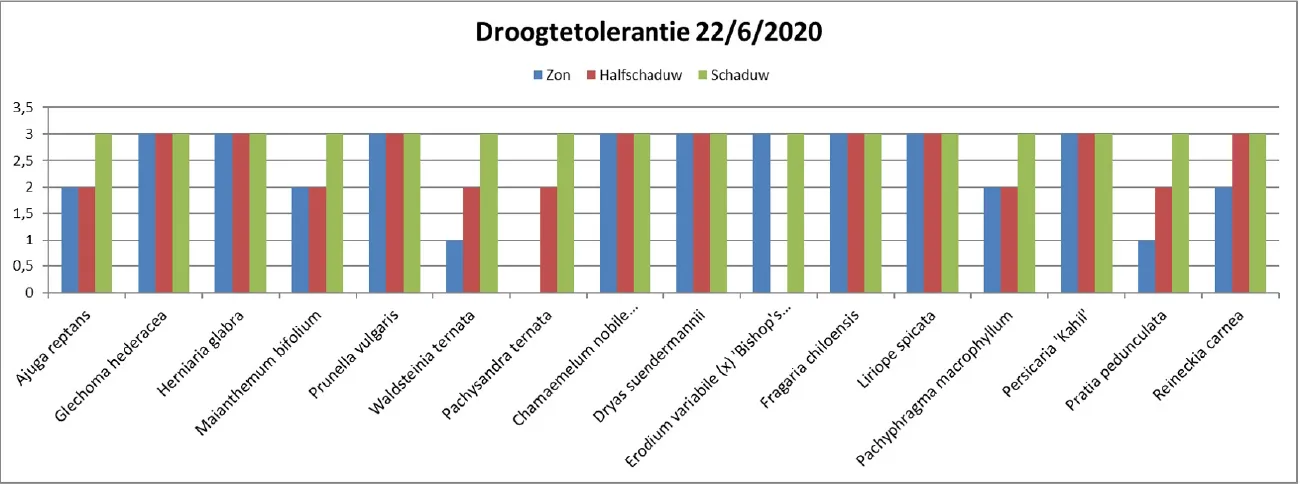
On 22/06/2020, following a prolonged dry spell, drought tolerance was scored (0 -> 3, with 3 indicating no drought damage), independently of ground cover. More shade-loving species proved noticeably more sensitive, as did some species that had performed well in sunny conditions, such as Ajuga reptans and Reineckia carnea. All species recovered well after a period of rain.
Ground-covering bedding plants
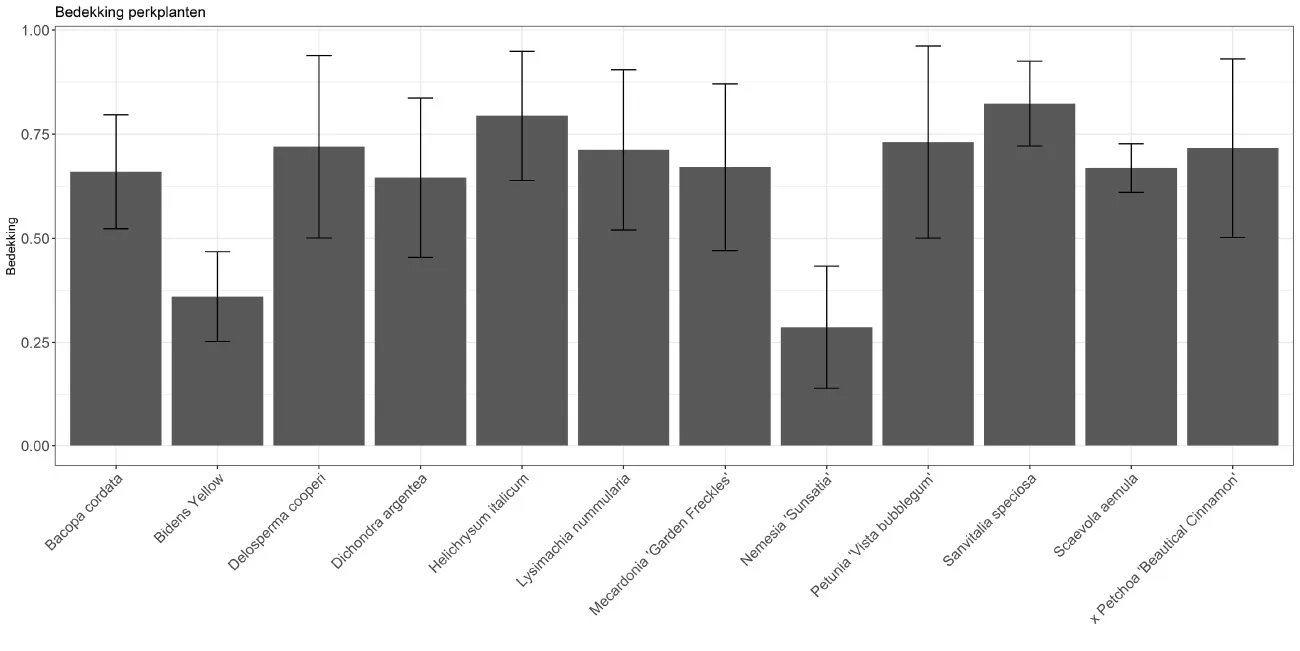
In both 2019 and 2020, alongside the perennials, plots of bedding plants were planted from June onwards, with Sanvitalia speciosa as the reference species. Their average ground cover increased rapidly after planting and remained relatively constant throughout the growing season.
Only Nemesia and Bidens had insufficient ground cover, and therefore inadequate weed-suppressing capacity. From June to September, bedding plants can certainly provide a full-fledged alternative to perennials for limiting weed pressure.
Future research: ground-covering shrubs and pre-grown plant mats on rolls
In 2020, ten species of ground-covering shrubs were planted: Hedera helix ‘Ivalice’, Hypericum ‘Black gem’, Lonicera nitida, Lonicera ‘Blond & beyond’, Potentilla ‘Bellisima’, Prunus pumila ‘Depressa’, Rhus ‘Gro low’, Rosa ‘Green summer’, Rubus ‘Betty Ashburner’ and Symporicarpos ‘Hancock low’. In the first year after planting, average ground cover had already reached 50 to 75 per cent, but the trial will continue to be monitored in 2021.
In 2021, a planting of Waldsteinia ternata and Vinca minor as pre-grown plant mats will be compared with planting in P9 pots. The difference in cost will be weighed against the time saved through faster establishment and reduced maintenance.
Research supported by the Flemish Government, the Agency for Innovation and Entrepreneurship, the European Union, the Province of East Flanders, Boerenbond and AVBS, the ornamental horticulture and green sector federation.
Question about this story? Ask your question
Keep following this
Get an email when a new story is published. No account needed.
- SubjectGeneral







