









A sustainable future for wheel loaders and articulated loaders
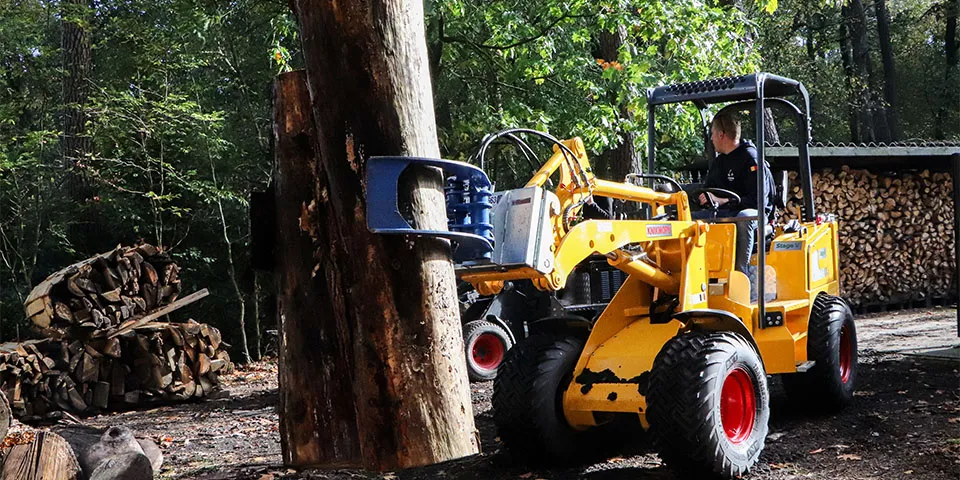
For more than thirty years, versatile machines for landscaping and other applications have been designed and manufactured at the Gebroeders Geens NV factory in Hoogstraten…
New technology in response to stricter emissions standards
For more than thirty years, versatile machines for landscaping, paving and other applications have been designed and manufactured at the Gebroeders Geens NV factory in Hoogstraten. The family business remains true to its core values while keeping its sights firmly set on the future. With several new developments, the second generation of the Geens family is striving for sustainable top performance and a greener future.
The mission of Gebroeders Geens NV has remained unchanged for thirty years: with the now familiar yellow Knikmops, the company aims to take the hard work off the hands of a wide range of contractors, quite literally. The compact articulated loader is therefore distinguished not only by its high breakout force and lifting capacity, but also by its ability to tackle a wide variety of jobs using an extensive range of hydraulically powered attachments. Various buckets and mowers, log splitters, weed brushes, rotary tillers and levelling frames make the Knikmops an exceptionally useful machine for garden professionals, among others.
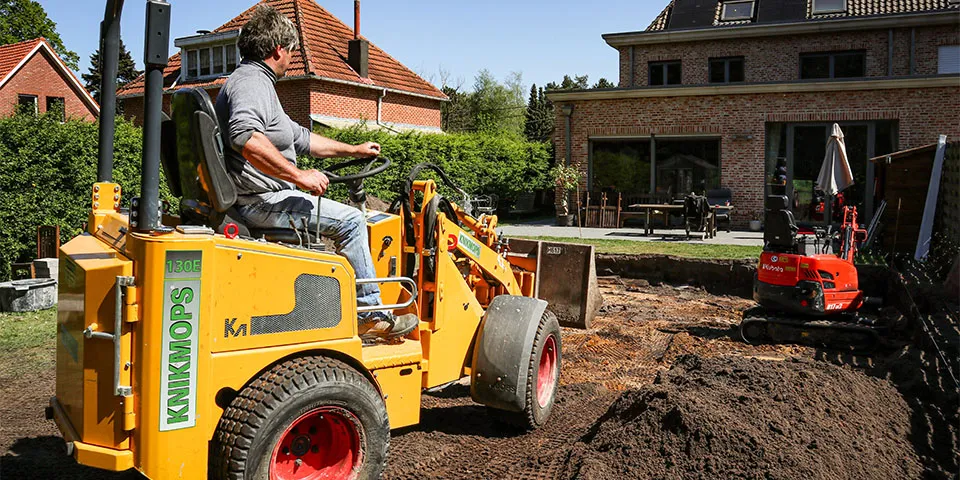
The electric Knikmops prototype is already undergoing extensive testing. During the construction of this swimming pool, its quiet motor helps preserve the peace and quiet for local residents.
Developed in-house
Like hand tools, however, wheel loaders and articulated loaders are also coming under pressure to deliver more sustainable performance. The European requirement to market only machines with Stage V diesel engines is fast approaching, and several manufacturers are already looking for electric alternatives. Gebroeders Geens NV has its own dedicated engineering department, which is now working hard to combine sustainable powertrains with the company’s core values of comfort, quality and reliability.
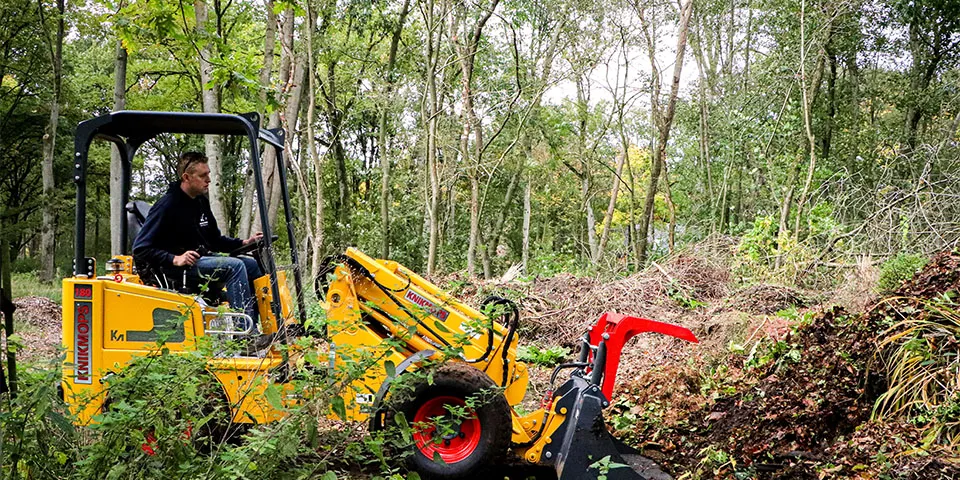
Bigger jobs call for bigger machines, such as the Knikmops 180 TE, shown here fitted with a grab bucket.
Stage V
Since the beginning of this century, Europe has set production standards to limit emissions from (diesel) engines. These have become progressively stricter, culminating this year in the Stage V standards. What does this mean? From 2021, only machines with Stage V diesel engines may be produced in the 56 kW and under and over 130 kW classes. These engines significantly reduce emissions, but are generally larger and more complex than their predecessors. “Installing an engine like this requires quite a few modifications to the machine,” says product specialist Bert Geens. “To keep the chassis of our Knikmops articulated loaders as compact as possible, without compromising operator comfort, we took the time to get the engineering just right.”
The smaller models could continue to be produced with Kubota engines after only minor modifications, but upgrading the larger models proved more challenging. “On the Knikmops 180 and 250, with outputs of 33 kW and 36 kW respectively, fitting the new Stage V engines required more careful adjustment, for example to accommodate the large particulate filter in our compact chassis. With support from the engine manufacturer, we managed to make it work. The new engines also give the machines excellent throttle response and quieter operation. The latter is often a decisive factor, particularly in urban areas.”
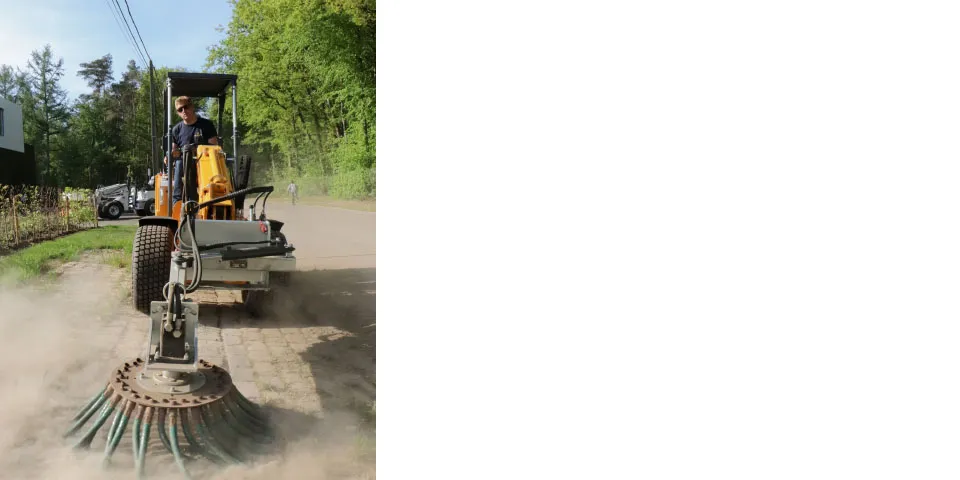
Thanks to its wide range of attachments, such as this weed brush, the articulated loader can be used for a wide variety of tasks.
Electric
An electric motor is quieter still, of course. “Following the automotive and hand-tool industries, there are also calls for further electrification in our sector,” says communications manager Marleen Geens. “But just as in those other sectors, range is a sticking point here too. If we are to launch a sustainable electric solution, it must, in our view, be just as reliable and user-friendly as its diesel-powered counterpart. That means it must be able to work a full day.”
Two prototypes have already been developed in the engineering department. “We have since developed a concept that is particularly energy-efficient and can therefore deliver long range with a smaller battery, and thus at a relatively low cost.”
“Several of our regular customers are now putting the prototype to the test,” Marleen Geens continues. “They use the machine in their day-to-day work, compare its performance with that of the diesel-powered Knikmops they know and trust, and send us a weekly logbook with detailed information on battery charge, work carried out, energy loss, charging time and so on. This gives us a clear picture of exactly how energy-efficient our electric Knikmops is and how our customers find the machine. So far, the results point to a bright future, in which a sufficient range is indeed achievable.”
Question about this story? Ask your question
Companies in this story
Keep following this
Get an email when a new story is published. No account needed.
- SubjectGeneral
- CompanyGebroeders Geens NV







