









A closer look at the groundsmen at Club Brugge
Text Elise NoyezImage Club Brugge
“The fixture schedule requires a great deal of flexibility from us”
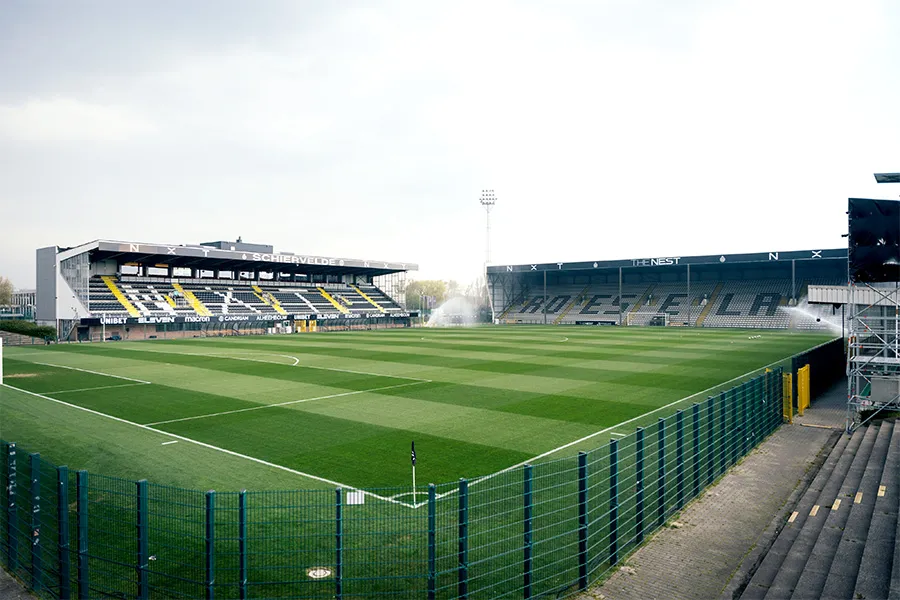
Belgian football is catching up. This is not necessarily about what happens on the pitch, but just as much about the pitch itself. “Clubs are increasingly understanding that a quality pitch also attracts better players and better football”, says Axel Geerinck, Head of Greenkeeping at Club Brugge. Over the course of his career, he has certainly seen greater appreciation for his work, and consequently more investment in it; only the fixture schedule still fails to take sufficient account of the needs of a quality pitch.
Geerinck leads a team of eight groundsmen, together responsible for no fewer than eleven natural grass pitches and two artificial pitches across three sites. In addition to the main pitch at Jan Breydelstadion and the four adjacent youth pitches, Club Brugge recently acquired a smaller stadium in Roeselare, as well as four training pitches for the first team and reserves in Westkapelle.
Modern technologies
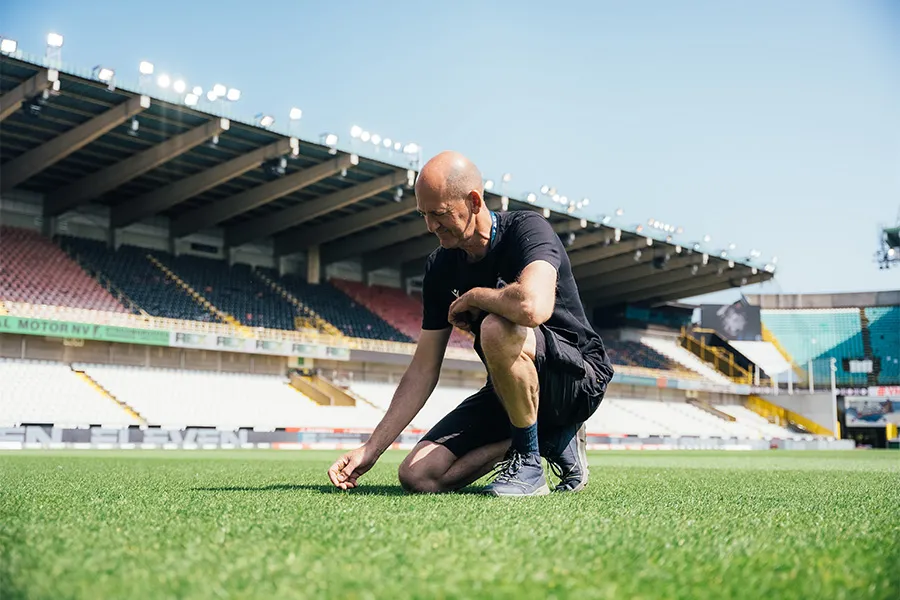
Club Brugge’s pitches are equipped with the most modern technologies, including irrigation, pitch heating and grow lights. “These are obviously expensive installations”, Geerinck says, “but they are undoubtedly worth the investment. We used to receive criticism of our pitches from time to time, but we have not had any complaints for years now.” In the current climate of extreme weather and product bans, such technologies are also becoming increasingly necessary, according to the groundsman. “Of course, we also use preventative biological methods to control weeds, pests and diseases, and use products such as wetting agents to make better use of water, but these are not always enough in extreme conditions. I have enormous respect for groundsmen at smaller clubs who manage to achieve the same results without modern equipment and budgets.”
“Of course, no technology is infallible. That is why, during the summer, we check both the pitch and the irrigation system every day, even when no one is supposed to be on site. Imagine if the irrigation failed during a dry weekend, just after sowing. All your efforts would have been for nothing. You always have to stay alert.”
Complex planning
The geographical spread of the pitches also requires extra attention and investment from Club Brugge. “If all the pitches were at one site, three good mowers would be enough, for example. Instead, we have twice as many so we can mow at all the sites at the same time. In principle, each site has its own team and site manager.
Only for larger projects, such as during the renovation period, does everyone help out at other sites, and we bring in external contractors for specific tasks, such as installing a new irrigation system.”
Geerinck also has to ensure that the necessary seeds, fertilisers, other products and equipment are always available at each site. “That requires quite a bit of coordination”, the groundsman admits, “although it is far from my biggest challenge. It is the fixture schedule that really worries me. The fact that two teams play on our A pitch, with both Club Brugge and Cercle Brugge playing their home matches at Jan Breydelstadion, means it is used every week, which obviously makes things more difficult. But the breaks are also getting shorter and shorter. This year, for example, we could not start renovation work until mid-June, while Cercle Brugge’s first friendly is already on 15 July. That does not give us enough time to renovate the hybrid pitch thoroughly. Instead of stripping it completely, this year we have had no choice but to limit ourselves to scarifying.”
Ready for play
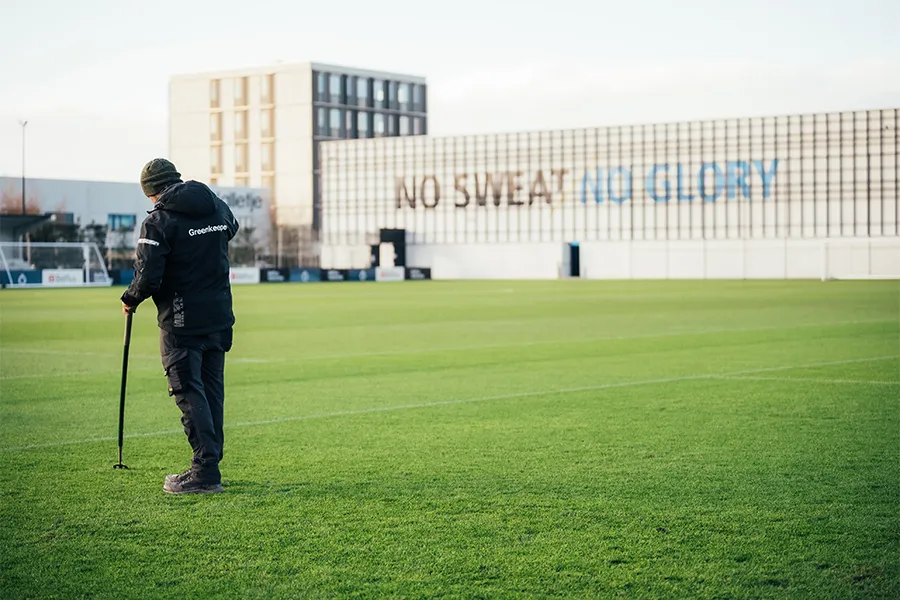
Geerinck sees a similar trend in the day-to-day running of the grounds. “Getting the pitches ready for play, like repairing them afterwards, is a daily task. This includes mowing, marking out and irrigating, as well as setting up the goals, corner flags and so on. On match days, however, this work now has to be completed three hours before kick-off to allow enough time to calibrate the VAR cameras. But when you consider that the preparatory work can easily take three hours and that many matches are played in the afternoon, you can quickly see that this requires a fair amount of ingenuity and improvisation in winter, when it is still dark in the morning and frost is common. In that respect, the Pro League could also pay more attention to groundsmen, something that may now be addressed with the establishment of a working group.”
Question about this story? Ask your question
Keep following this
Get an email when a new story is published. No account needed.
- SubjectGeneral







