How can you future-proof golf course management?
Text Kris VandekerckhoveImage Pexels/Pixabay
Six greenkeeping trends for 2025
At the start of the season, it makes sense to take a step back and look at the bigger picture. New technology, stricter regulations and changing climatic conditions call for a fresh approach to maintenance, budgets and playing quality. The following six trends show where greenkeepers and decision-makers alike can make the greatest impact in 2025.
1. Electric equipment goes mainstream
Battery-powered mowers and utility vehicles now offer the power and operating times needed for day-to-day maintenance. Alongside lower emissions and noise levels, reduced maintenance requirements are a key advantage: no engine oil, no fuel filters and less wear. However, it is important to organise charging. Consider a centralised charging schedule and sufficient charging points around the maintenance facility and course. A phased introduction, starting with short-cycle tasks such as greens or tees, helps spread peak loads and investment costs.
2. Autonomous mowing technology is gaining ground
GPS- and radar-guided robots are rapidly moving from rough management to fairways. They work consistently within virtual boundaries, make thousands of small cuts a day and thereby reduce stress on the grass. For the greenkeeper, the focus shifts to supervision, maintenance and route planning. Safety remains crucial: clearly defined no-go zones and a correctly configured geofencing system help prevent incidents involving players or wildlife. Experience shows that starting on less critical areas, such as semi-rough, offers staff and management a safe opportunity to learn.

3. Carbon- and soil-focused fertilisation
Input costs are rising, while chemical pressure must fall. Fertilisers with a high organic carbon content support soil life and bind nutrients, reducing the risk of leaching and making the turf more resilient. Many courses are therefore combining a lighter NPK programme (nitrogen/phosphorus/potassium) with periodic applications of soil improvers or liquid biostimulants. To measure the effect, a simple baseline assessment of organic matter content, pH and CEC (cation exchange capacity) is sufficient. A regular monitoring cycle makes it easier to make timely adjustments.
4. Data-driven irrigation and water reduction
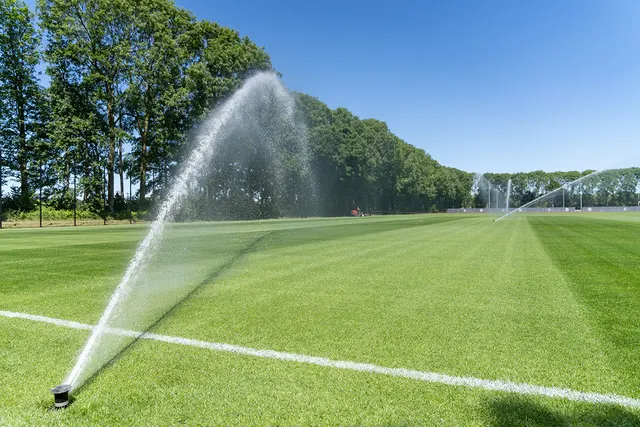
Soil moisture and temperature sensors, linked to weather forecasts, are enabling increasingly precise control of irrigation pumps. Results indicate water savings of up to a third and a demonstrably healthier rootzone thanks to fewer extremes in soil moisture. Investment usually starts with a pilot on the greens: one receiver, several wireless probes and a connection to the existing control software. Once the data prove reliable, the hardware can be extended to tees and fairways. Further gains can be made by combining this with pressure-controlled pumps and variable-nozzle technology.
5. Labour shortages call for smarter planning
An ageing workforce and competition from other sectors mean that the number of greenkeepers available continues to fall. Digitalisation offers a way forward: task and machinery planning software gives a clear picture of the workload, links hours to costs and helps set priorities. The focus is also shifting from simply carrying out tasks to skills such as data interpretation, maintaining electric drivetrains and programming autonomous units. Clubs that invest in their own training programmes, in partnership with local training centres, tend to have the lowest staff turnover.
6. Biodiversity and ESG reporting
Permits, subsidies and member expectations are placing increasing emphasis on measurable environmental performance. Golf courses are therefore investing in flower-rich rough strips, minimal pesticide use and water buffer zones. Digital habitat maps and regular biodiversity surveys provide the basis for reporting in ESG reports (Environmental, Social & Governance). A practical benefit is that visible environmental management enhances a course’s reputation and can lead to new partnerships, for example with conservation organisations or local authorities. It is worth choosing one or two clear KPIs, such as the percentage reduction in pesticide use or the number of species recorded, and communicating them consistently.
Conclusion
Electrification, automation, soil improvement, precision water management, staff development and biodiversity together provide a framework for future-proof golf course management. By launching one pilot project at a time and making the results measurable, a club can invest strategically and scale up step by step. This helps maintain high playing quality and ensures the management team is prepared for the challenges of tomorrow.
Question about this story? Ask your question
Keep following this
Get an email when a new story is published. No account needed.
- ThemeKeeping golf courses playable all year round
- SubjectConstruction & management