City of Antwerp: Green Deal for Sports Facilities in action
Text Kris VandekerckhoveImage Machineland / Stad Antwerpen
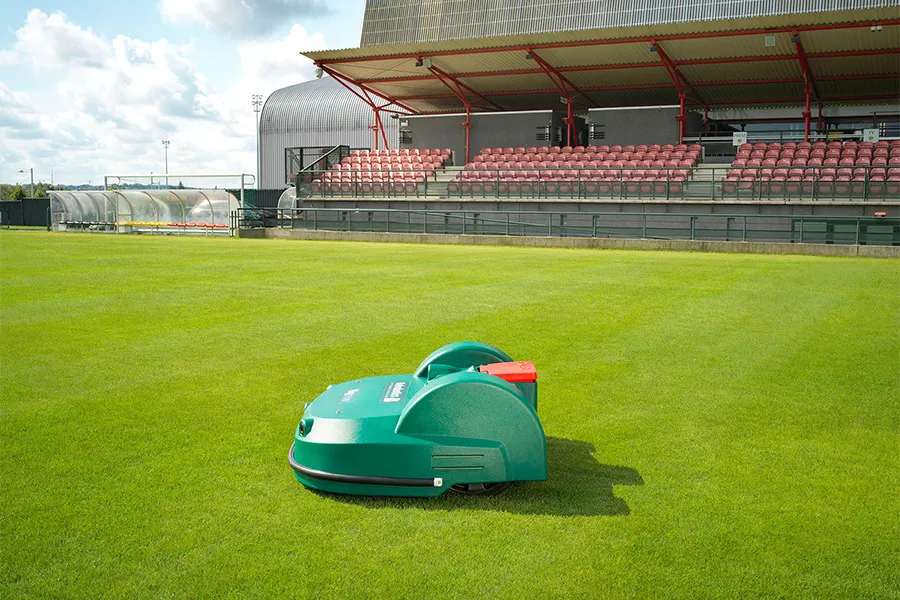
Robotic mowers make grounds maintenance more efficient
To make sports facilities greener and more sustainable, several partners, Sport Vlaanderen, the Flemish Environment Agency, the Flemish Sports Federation and Netwerk Lokaal Sportbeleid, together with the Flemish Government, have joined forces behind the Green Deal Sportdomeinen. This makes sense when you consider that Flanders has almost 10,000 outdoor sports facilities covering more than 17,500 hectares.
The Green Deal Sportdomeinen, not to be confused with the European Green Deal, covers areas including soil quality, efficient water management at sports facilities, reducing pesticide use and integrating sports areas into so-called green-blue networks. Together with various public partners and private-sector stakeholders, the government will share its knowledge on the construction, maintenance and use of outdoor sports facilities, such as football pitches, golf courses, gravel courts, natural grass pitches and artificial turf pitches.
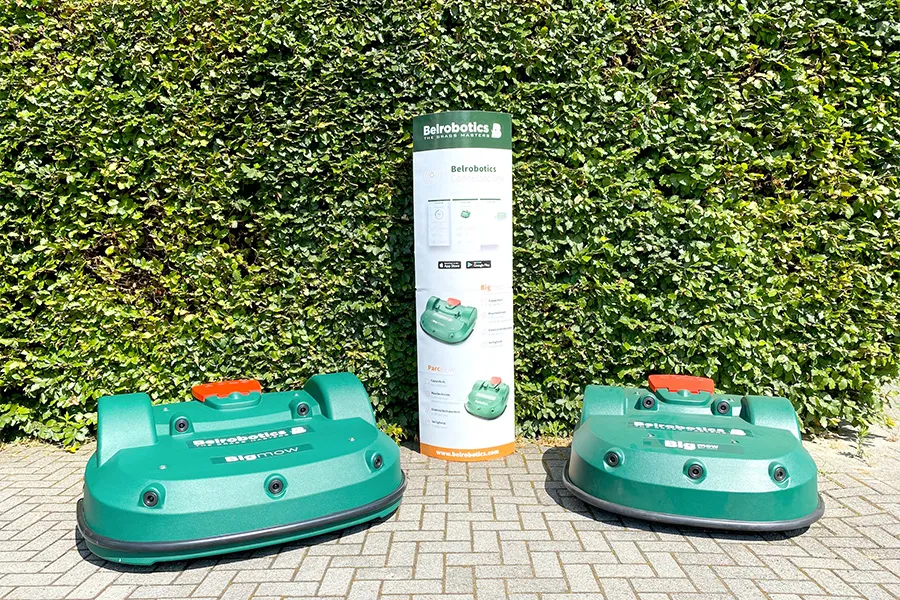
Robotic mowers for large areas
One of the stakeholders that quickly recognised the need for this and got on board was Belrobotics, based in Wavre. Belrobotics entered the commercial robotics market in the early 2000s. Its robotic mowers are used to maintain sports facilities (football, rugby and golf), private gardens of all sizes, and green spaces around business parks, hospitals, hotels, country clubs, local authorities, military bases, airports…
Mick Van Keer, Machineland (Antwerp Region): “Machineland is the City of Antwerp’s regular supplier of a range of horticultural machinery, including robotic mowers from the Belrobotics brand.
The brand has made a name for itself with professional robotic mowers for large areas (up to 75,000 m² using GPS RTK), including golf courses and football pitches… We have been supplying robotic mowers to the City of Antwerp for five years, mainly models suited to areas of 12,000 m² and 24,000 m². We work very closely with Steven Papen on this.”
Challenges
Steven Papen, team leader, City of Antwerp: “We don’t have the title ‘greenkeeper’, but we’ve been building up our expertise for fifteen years now. There are six of us, and we’re responsible for maintaining 23 natural grass football pitches and 14 artificial turf pitches in Greater Antwerp. When I took over the role from a colleague about fifteen years ago, the renovation process was fairly straightforward. It involved treating the pitches with Bofix, levelling them with topsoil and overseeding. After the VMM campaign (www.zonderisgezonder.be), we changed our approach, because, after all, as a public service we have a duty to set an example.”
“But waterlogging was a major problem. We tackled it by verti-draining during renovation and brushing in white sand to improve drainage. The fertilisers we were using were also better suited to crops than to turf, so we looked for a solution and found one in coated, slow-release fertilisers, with an NPK ratio tailored for application three times a year. Combined with verti-draining, this delivered more targeted nutrients and oxygen to the grass. As a result, the grass grew even better, and keeping up with its growth became a challenge. That’s when robotic mowers came into the picture.”
Mowing both at night and during the day
Steven Papen: “The robotic mowers have been supporting us for several years now, and they work very well. They save us time and machinery. No employee has to drive out to a pitch twice a week to mow it, and there are no grass clippings to clear. The robots are on site and can mow both at night and during the day. You can monitor everything in the app, including error messages and/or alarms, so we can respond quickly if needed. You can also programme different schedules or decide at a moment’s notice to start the robot remotely.”
“The robotic mowers are very important for the city because they give staff more time to carry out other important tasks. Previously, someone had to use the ride-on mower several times a week to mow each pitch repeatedly. Now the robotic mower does this fully automatically. The constant ‘mulching’, returning the grass to the soil in very finely chopped pieces, also provides natural fertilisation. So, in theory, this reduces the amount of fertiliser used by you as the end customer. That’s a good thing,” concludes Mick Van Keer.
Question about this story? Ask your question
Keep following this
Get an email when a new story is published. No account needed.
- ThemeAutonomous operations in green spaces
- SubjectConstruction & management